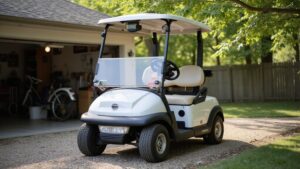
Wondering if you need a license to drive a golf cart? The answer depends on where you’re driving. On private property like a golf course, you usually don’t need one.
But on public roads, most states require a valid driver’s license, along with registration and insurance. Keep reading to learn the specific rules that apply to your situation.
Do You Actually Need a Driver’s License for a Golf Cart?
Whether you need a driver’s license for a golf cart depends on where you’re driving. On private property like golf courses or gated communities, you generally do not need a license, making it simple to enjoy using the cart for fun or quick transportation within the area. However, it’s still important to check local rules and age restrictions for off-road use, even if no state license requirements apply. Before heading out, also consider how your intended terrain might shape your choice, since lifted models are better suited for rough off-road conditions. Denago golf carts, for example, are often praised for their robust build quality and reliable performance on varied terrain. Once you take your golf cart onto public roads, almost all states require a valid driver’s license. For example, states like South Carolina and Florida mandate that drivers be at least 16 years old and carry identification. Nevada also requires a licensed driver for daylight operation on public roads. To keep your cart running reliably, you should follow the proper charging steps for the batteries to avoid damage and extend their lifespan. Always verify the local regulations before customizing your cart with modifications like lift kits or custom seats, since licensing requirements can change based on your location.

Compatibility: 6'' drop axle lift kit fits compatible with your 2001.5~2020 EZGO TXT electric models. (NOT FOR RXV MODELS)

The Front End Lift Block for Club Car DS Gas and Eelectric Models;
Private vs. Public Roads: What’s the Real Difference?
The main difference is that on private roads, you set the rules, while on public roads, you must follow the law. Public roads are under full government jurisdiction. States like South Carolina require you to have a permit, register your vehicle, and carry liability insurance. To operate legally on public roads, the vehicle must meet specific street legal requirements for safety equipment. Florida only allows carts on designated roads, usually with low-speed limits. Equipment rules, such as lights, mirrors, and seat belts, are mandatory on public roads but generally not needed on private property. Ultimately, if you’re on private land, you are governed by the owner’s rules. When driving on public roads, you need to adhere to established traffic laws and safety regulations. Before buying, keep in mind that a used golf cart typically costs between $3,000 and $15,000 depending on age, condition, and included features. Nearly all states require a valid driver’s license even for low-speed golf cart operation on public streets.

MULTI-STORAGE: Our golf cart organizer tray offers various storage options for organizing all your items neatly; Possess 8 storage areas: 2 side insulated cup holders, 3 mesh pockets, 2 square compartments, 1 cooling compartment, it is easy to hold your balls, tees, sunglasses, cell phone, drinks (Note: Not compatible for the golf cart with windshield)

Sturdy & Long-Lasting: Our golf cart storage basket is crafted from sturdy and wearproof 1680D Oxford fabric, designed to withstand various weather conditions and frequent use. The interior is reinforced with PP support panels to prevent sagging or deformation, ensuring stability and maintaining its shape over time. Additionally, the golf cart storage basket features a foldable and portable design, making it easy to install, store, and transport without taking up excessive space

NOTE!!! Doesn't fit the couch-type rear seat set and plastic type rear seat armrest kit, doesn't fit Club Car Tempo. ONLY fits 2+2/4 Passenger Golf Carts or Rear Seat Kits with Flip-Up Extensions
Minimum Age for a Golf Cart Driver’s License: Can a 14-Year-Old Drive?
A 14-year-old generally cannot legally drive a golf cart on public roads. Most states set the minimum age at 16 or higher for operating a motor vehicle that’s registered for public use. For example, Washington requires drivers to be at least 16 and to have completed driver education or have prior licensed-driving experience. California also mandates a valid driver’s license to drive on public streets, effectively raising the minimum age to 16. Florida has recently tightened restrictions, preventing most 14-year-olds from driving golf carts on public roads. However, laws vary depending on the state and local regulations. Some areas may allow younger drivers to operate golf carts on private property or designated areas with adult supervision or a learner’s permit. It’s essential to check your local ordinances before allowing a 14-year-old to drive. Understanding the golf cart battery voltage is also key for safe operation and maintenance. Driver education is often a prerequisite for younger operators to ensure they understand the rules and safety measures involved. For those who do meet the legal requirements, choosing a lifted cart model can improve both performance and stability on uneven terrain. For buyers prioritizing overall reliability, reviewing top picks for quality and performance can help identify the most suitable models.
What States Require a License for Street‑Legal Carts?
Most states require a valid driver’s license to operate a street-legal golf cart on public roads. Louisiana, Montana, and Tennessee explicitly mandate this requirement. New York and Pennsylvania enforce similar rules for low-speed vehicles, which includes many street-legal carts. In these states, you must have a license even if your cart meets equipment standards and complies with roadway signage. For those looking to make their carts street-legal, selecting a reliable turn signal kit is an essential step to meet equipment standards and improve safety. Understanding what a golf cart controller does can help owners ensure their cart’s speed control system meets street-legal requirements and operates safely. Florida is an exception. Adults aged 18 or older can use a government-issued photo ID instead of a driver’s license. However, operators under 18 still need a valid learner’s or driver’s license. Many states also restrict street access to local permits or authorization, so it’s essential to check your county or city regulations. Buyers should also consider the overall purchase cost when budgeting for a street-legal cart, as prices vary widely based on features. Always verify your state’s rules before taking your golf cart onto public roads, as requirements can vary widely.

[Compatible Cart Models]: Golf cart universal turn signal kit (Plug & Play) with horn brake light switch fit 12V Club Car, EZGO, and YAMAHA (not fit Club Car Precedent)

[Vehicle Compatibility]: Universal golf cart turn signal kit (Plug & Play) designed for 12V systems. Compatible with most EZGO, Yamaha and Club Car models (Important Note: NOT compatible with Club Car Precedent models)

Upgrade kit make your golf cart has turn signal, horn, hazard flashing, brake lights functions, fits golf cart light kit with 9-pin plug wiring harness
What Speed Limits Apply to Golf Carts on Public Roads?
You can cross a 35 mph highway at designated intersections with a traffic light, but this does not mean you are allowed to drive along that road afterward. Crossing permissions are limited to specific points and do not grant ongoing access. Always remember that crossing is not the same as traveling on that road; your golf cart must remain within designated crossing zones and adhere to local rules. Before setting out, you should perform a safety inspection of your cart’s battery and connections to ensure reliable operation. Exceeding speed limits or driving beyond the crossing area can lead to fines or other penalties. In Florida, driving rules for golf carts require operators to have a valid driver’s license and follow specific road regulations. Choosing the right power source, such as top lithium batteries, can help your cart maintain the speed needed to comply with these local road rules.

Born for 48V Golf Cart: Special designed for 48v golf cart industry, OGRPHY 48v lithium golf cart battery is compatible with golf cart controllers of all major brands on the market. Built in premium grade A prismatic LiFePO4 cells(UL certified), this 48v battery has better durability & safety. Over 5kWh capacity equals 8pcs 12V 100AH lead acid batteries. Max 10.24kW continuous power & peak 51.2kW power (50% more powerful than standard lithium batteries) to conquer hills/rough terrain effortlessly.

[10 Years Lifetime and 5000+ Deep Cycles] OGRPHY 48 volt lithium battery is made of new grade A cells with UL certification. 10 years lifetime and 5000+ deep cycles is not just a slogan under instructions on the product manual.

Get Rid of Lead Acid Batteries Now: Revolutionize your golf cart with Lithova 48V golf cart lithium conversion kit! This 48V lithium battery directly replaces 6-8V 50Ah heavy lead-acid batteries in one simple installation. Enjoy 74% weight reduction, 60% smaller size, and extended 25-mile range (effortless 3-5 Rounds of 18-hole courses). Lasts 8x longer than lead-acid batteries, Up to 15000 deep cycles ensure maintenance-free performance and long-term reliability.
When Can a Learner’s Permit or Government ID Be Used?
A learner’s permit or government-issued ID can be used based on your age. If you are under 18, a valid learner’s permit is required to operate a golf cart, and it cannot be expired or used as a substitute for a full license. If you are 18 or older, a government-issued photo ID such as a driver’s license or state ID card is sufficient to prove your identity and age. It’s important to carry the correct credential for your age group to operate the vehicle legally. Carrying an expired permit or using a permit outside of its intended purpose does not meet legal requirements. Remember, while these IDs establish your eligibility to operate a golf cart, they do not replace other legal obligations like registration or insurance. Always verify that your registration and insurance requirements are in order before taking a drive. Additionally, ownership paperwork varies by state, so be sure to confirm what documents are needed for your specific situation. For added style and protection, you might also consider top hub caps that complement your golf cart’s wheels. Upgrading to lithium batteries can improve your golf cart’s performance and reduce maintenance needs.
Do You Need Registration, Insurance, or a Special Permit?
Registration, insurance, and permits depend on where and how you plan to use your golf cart. If your cart qualifies as a low-speed vehicle, you will need to register and title it similarly to a car. This process often involves paying a fee and submitting an application to your local DMV or transportation department. Cities may also require you to obtain a local permit, which can include additional fees and specific application procedures. If you are looking for a cheap option, reviewing top affordable ride comparisons can help you understand which models qualify differently under local laws.
Insurance requirements vary widely. On private property, standard golf carts typically do not need insurance coverage. However, if you drive on public roads, liability insurance is usually mandatory to cover possible damages or injuries you might cause. Some states, such as South Carolina and Florida, explicitly mandate insurance for any registered or permitted golf cart. Low-speed vehicles often have extra insurance requirements, including personal injury protection. Always check your local and state regulations carefully to determine what specific coverage you need before taking your golf cart onto public roads. If you plan to carry gear on your golf cart, consider a roof rack that meets safety standards.

Compatibility: Compatible with EZ-GO TXT 1994-2013 golf cart,Golf cart roof rack size: L50 x W33 x H5 inches

【LARGE STORAGE CAPACITY】Free up space in your vehicle with this roof rack cargo basket that can hold up to 200 LBS. Overall dimensions include: 46 in (L) x 36 in (W) x 5 in (H)

Applicability: The roof basket is suitable for crossbars with a maximum width of less than 3.9 inches and a maximum thickness of less than 1.3 inches. For safety reasons, we recommend using 2 crossbars for the 51-inch roof rack.
How Seat Belt and Passenger Rules Apply to Golf Carts
Seat belt and passenger rules for golf carts vary based on where you’re driving. If your cart is classified as a low-speed vehicle (LSV) for public-road use, you are required to wear a seat belt at every seating position, whether on private property or public roads. Wearing a seat belt is your best protection against ejection in case of sudden stops or collisions.
Passenger capacity is limited to the number of seats available, and you must not allow lap seating, standing riders, or anyone on the rear platform while the cart is moving. The driver must ensure everyone is properly seated before driving. Children should never be held on a lap; they need their own seat with a properly fitting seat belt. Always stay fully seated with feet on the floor until the cart comes to a complete stop before exiting.
Check Your Local Laws Before You Drive: A Quick Guide
Before driving a golf cart on public roads, you must verify your local laws. Regulations differ significantly depending on your location. Some areas limit carts to specific roads with posted speed limits, while others require a permit, decal, or municipal approval. Remember, private-property rules do not automatically apply to public streets—they are often more stringent. Your license, age, and insurance requirements will also vary; in many jurisdictions, a valid driver’s license is necessary for road use, typically requiring drivers to be at least 16 years old. Registration and liability insurance might be mandatory as well. Proper golf cart maintenance becomes essential if you’re permitted on roads—faulty brakes, lights, or tires can lead to citations. Additionally, off-road restrictions may prohibit carts from certain trails or unpaved paths. Always review your city code, county ordinance, and state DMV guidelines before taking your golf cart onto public streets.