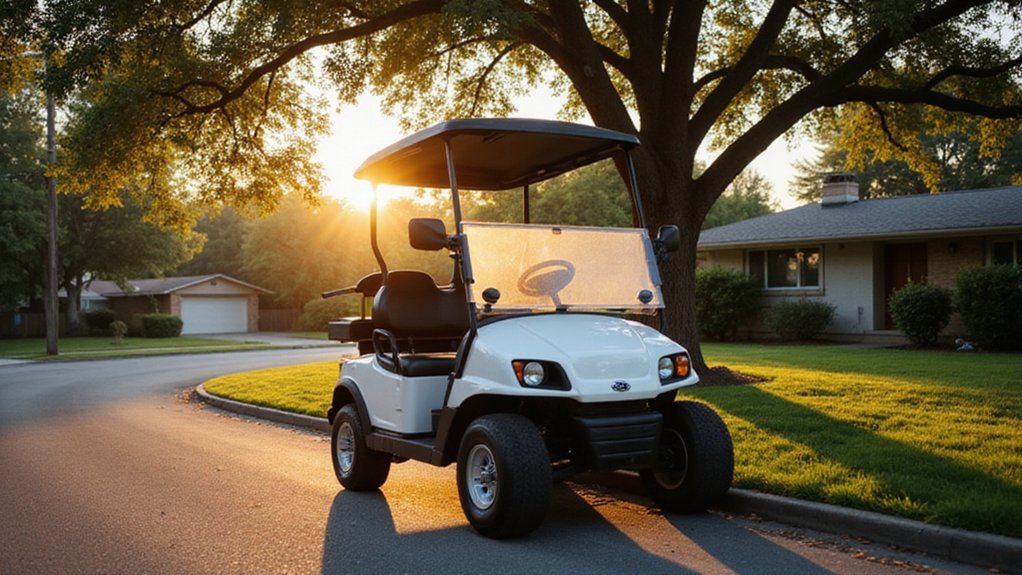
Thinking about making your golf cart street legal? The process involves meeting specific safety standards and legal requirements that can vary by location. Usually, you’ll need features like headlights, turn signals, and seat belts.
Along with these features, you’ll need a few key documents and inspections. Keep reading to find out exactly what it takes to get your cart ready for the road.
What Exactly Makes a Golf Cart Street Legal?
To make a golf cart street legal, it must be officially classified as a Low-Speed Vehicle (LSV), not just a standard golf cart. An LSV is designed to operate on public roads at speeds typically between 20 and 25 mph. Achieving this classification requires more than just adding extra lights or accessories. Off-road modifications or cosmetic changes won’t satisfy the legal requirements for on-road use. Instead, you need to equip your cart with:
- Headlights and brake lights
- Turn signals
- A windshield
- Side mirrors
- A horn
- Seat belts
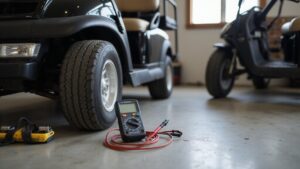
Additionally, local ordinances must approve your modifications, and your cart must meet specific safety standards. However, understanding the difference in running costs and lifespan between a golf cart and a UTV is crucial when deciding which vehicle to invest in for potential street-legal conversion. Following a step-by-step walkthrough can help you ensure all necessary equipment is installed correctly and safely. For example, using a multimeter for voltage testing can verify your new lighting components function properly before finalizing installation. Without meeting these criteria and securing proper classification, your golf cart remains restricted to private property and cannot be legally driven on public roads.

[Premium Lighting Upgrade]:Upgrade your golf cart with this deluxe light kit, designed for 1996-2013 gas and electric carts This high-quality lighting kit is the perfect solution to enhance both the functionality and appearance of your golf cart Whether you're cruising around the neighborhood or hitting the course, premium lighting will ensure you stand out and stay safe
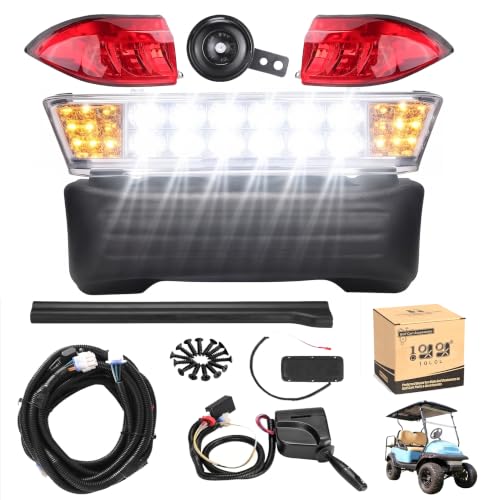
Club Car Precedent Fitment: Designed for 2004-2018 Club Car Precedent gas and electric golf carts, 12V street-legal light kit with headlight, taillight, turn signals, horn, brake pad, and hazard functions

[Compatible Cart Models]: Golf cart universal turn signal kit (Plug & Play) with horn brake light switch fit 12V Club Car, EZGO, and YAMAHA (not fit Club Car Precedent)
The 6 Core Federal LSV Standards for a Street-Legal Cart
To be considered street-legal under federal standards, your Low-Speed Vehicle (LSV) must meet six core FMVSS 500 requirements. It needs a four-wheel design and a top speed ranging from 20 to 25 mph on paved, level surfaces. The vehicle’s gross weight cannot exceed 3,000 pounds, ensuring it remains within the safety and performance limits set by regulations.
Your cart must be equipped with a federally approved windshield to protect occupants from debris and weather. Seat belts are mandatory at every seat for safety, and a parking brake must be installed to prevent undesired movement when stationary. Rear visibility features like mirrors and reflectors are essential to ensure your cart can be safely operated in traffic. Because the law classifies an LSV differently from a standard golf cart, understanding insurance requirements is crucial for legal road operation. For those prioritizing longevity and power, selecting a cart with top lithium golf carts can improve compliance by maintaining consistent speed and reducing battery maintenance. A review of Top Golf Carts can help buyers compare models that meet all federal standards.
Regular maintenance of the batteries guarantees consistent speed and reliable power, which are important for maintaining compliance. Correct tire pressure is critical too; under-inflated tires can negatively affect handling, safety, and the vehicle’s speed accuracy. Finally, your cart must display a federal certification label affirming its compliance with FMVSS 500 standards. Without this label, your golf cart cannot be legally operated on public roads under federal law.
Headlights, Turn Signals, and Brake Lights Required for Road Use
Headlights, turn signals, and brake lights are essential for legal road use. Your headlights must face forward and be bright enough to light the road well without blinding other drivers. Off-road spotlights do not meet this requirement. Turn signals should be visible from at least 100 feet in sunlight, both on the front and rear, and many areas require hazard flashers as well. Brake lights need to activate immediately when you press the brake pedal, not just serve as taillights. Proper wiring is crucial; loose connections can lead to failures and safety issues. Use appropriate tires that can handle road speeds to keep your lighting system stable. While installing these components, consider that a quality hinge ensures your windshield stays secure at higher speeds, preventing vibration damage to your electrical connections. Selecting top hub caps also helps maintain wheel balance and a professional appearance suitable for street use. While federal standards set the basic requirements, always verify local laws to ensure compliance with stricter rules. For reliable power, consider a lithium battery conversion kit to ensure your lighting and signals operate at full voltage without sag.

【Compatible Models】: Golf cart headlight taillight kit fit EZGO TXT 12V 1996-2013 gas and electric, please check your model to make sure your model is fit

[Fit Models]: Deluxe golf cart led light bar kit fits gas&electric EZGO TXT golf carts 1996-2013. It not only enhances visibility with superior light output at night but also significantly improves the overall functionality and style of your golf cart
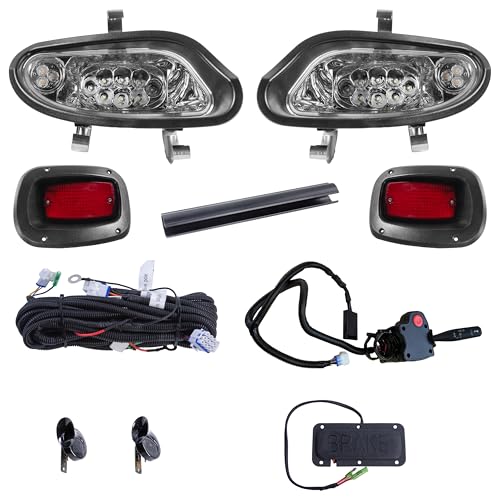
Complete LED Lighting Upgrade: This kit includes LED high low beam headlights, LED taillights, upgraded wiring harness, deluxe turn signal switch, and horn for your EZGO TXT FREEDOM golf cart (2014+ models).
Windshield, Mirrors, Seat Belts, Horn, and Parking Brake Requirements
To make your golf cart street legal, you must include several non-electrical safety features. Your windshield needs to meet federal windshield standards, which typically means using DOT-approved laminated safety glass rather than a flexible acrylic panel. Proper mirror configurations are essential as well: you need at least a driver-side exterior mirror and either a passenger-side exterior mirror or an interior mirror. Seat belts are non-negotiable; you must install lap-and-shoulder belts at all seating positions to ensure passenger safety. A functioning horn is required to serve as an audible warning device for other traffic. Additionally, your vehicle must have a parking brake capable of holding the golf cart on a grade independently of the service brakes. All of these elements are core requirements for your vehicle’s inspection and legal street use. For reliable electrical system operation, you also need a properly functioning solenoid for EZGO models to ensure the starter and power circuits engage correctly. Choosing a deep cycle battery ensures consistent power delivery for your cart’s electrical components during road use. Protecting your investment with a top cover for golf carts can shield these components from weather damage.

DOT APPROVED WINDSHIELD: Made from abrasion-resistant polycarbonate to meet DOT AS4 and AS5 specifications, increasing durability and protection from the elements

PREMIUM 5MM HIGH-DENSITY ACRYLIC – With a harder, more durable material than that of standard windshields for superior strength; has removable protective films to prevent scratches during shipping and installation

MADE TO FIT: Compatible with Star EV Sirius Golf Carts, this windshield is custom cut to provide a snug, vibration-free fit
Speed Limits and Roads Where a Street-Legal Cart Can Drive
You can legally drive your street-legal golf cart on roads posted at 35 mph or less. Some areas implement stricter limits, such as 30 mph, so always check local signage. Your safest options are local secondary roads and designated golf-cart zones. You are not permitted to drive on highways, interstates, or freeways, or any road exceeding the posted speed limit. Crossing a higher-speed road at an intersection is allowed if local rules permit, but you cannot drive along it. Always verify road signage and local ordinances before operating your cart. Modifications to your golf cart do not change these restrictions; its top speed remains the governing factor. Daytime operation is typically standard unless you have added proper lighting for visibility. Confirm both the speed limit and street designation before you set out. In most jurisdictions, riding on sidewalks is illegal for any motorized golf cart, even if it is street-legal. In Illinois, you must also comply with specific state equipment requirements to obtain street-legal status.

[Suitable For]: Deluxe golf cart Led light kit compatible with Club Car Precedent 2004-up electric golf carts (Note:If your golf cart is a gas model, please purchase a 12-pin to 9-pin adapter yourself)

[Compatibility & Voltage]: Golf cart LED Headlight Tail Light Kit Fits 1993-Up Club Car DS Gas & Electric models. Requires 12V operation (voltage reducer needed for 36V/48V carts)

[Compatible Models]: This golf cart headlight taillight street legal kit is for 1993-up Club Car DS models gas and electric. Please check your model to ensure a proper fit
How to Get a VIN, Title, and License Plate for Your Cart
To get a VIN, title, and license plate for your cart, you need to first classify it as a Low Speed Vehicle (LSV). Factory LSVs already come with a 17-digit VIN printed on the frame. If your cart is converted, your state will typically require an inspection to verify it meets safety standards and may need to assign a VIN afterward. To prove ownership, gather documentation such as a Manufacturer’s Certificate of Origin or a bill of sale. Submit these along with your registration and title application to your local DMV. In states like Florida, the process involves a bundled package that includes inspection, VIN assignment, and license plate issuance, all done in one visit. Make sure your golf cart rims meet the necessary road standards and that your battery is well-maintained; a dead battery can cause inspection failure. Once everything is approved, you will receive your license plate. To keep your cart running reliably during the process, consider investing in top golf cart batteries that ensure consistent power and performance. Selecting a reliable lithium battery can also improve overall efficiency and provide longer life compared to traditional lead-acid options. Always practice safe pedal control when testing your cart, as sudden acceleration or braking during an inspection can raise safety concerns. Keep in mind that DMV procedures and requirements vary by state, so always check your local regulations before starting the process.
Driver’s License and Insurance Requirements for Street-Legal Carts
To operate a street-legal golf cart on public roads, you must have a valid driver’s license, typically requiring you to be at least 16 years old, depending on the state. You are expected to carry this license while driving the cart. States like Florida and South Carolina enforce these licensing rules strictly, ensuring that only licensed drivers can operate low-speed vehicles on streets. Understanding the power source is also essential, as most low-speed vehicles rely on a 48-volt system to meet performance standards. You should also have proof of ownership paperwork like a title to register a cart for road use in many states. For off-road use, many owners install lift kits to improve ground clearance and stability.
In addition, active insurance coverage is mandatory once your golf cart qualifies as a low-speed vehicle. This often means securing insurance policies that meet or exceed the state’s minimum requirements. For example, Florida requires personal injury protection and property damage liability coverage. Virginia and South Carolina treat your golf cart like any other motor vehicle for insurance purposes, which means you need proof of coverage when driving on public roads. Always verify that your insurance coverage aligns with local standards before taking your golf cart onto the street.
State and Local Laws That Add Extra Requirements for Your Cart
Even if your golf cart meets state requirements, local laws can impose additional rules you must follow. Cities often restrict where you can drive—for example, limiting operation to roads posted at 30 mph or less. They may also enforce time-of-day restrictions, typically allowing golf carts only during daylight hours. Beyond the basic features, you might need to add specific accessories such as turn signals, seat belts, or reflective devices to stay legal.
Always check your city or county’s regulations before hitting the road. Many places require separate registration, decals, or permits specific to golf carts. You might also need to follow designated routes or crossing points where golf carts are allowed. Failing to comply with local permit procedures or equipment requirements can result in fines or other legal issues. In short, adhering to local laws and obtaining any necessary permits is crucial for legal and safe operation.