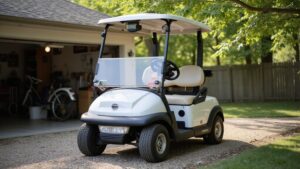
Thinking about buying a golf cart but feeling overwhelmed by options? You’ll need to decide between electric or gas, standard or lifted models, and how many seats fit your needs.
The right choice depends on your typical use, terrain, and local rules. Keep reading to find out everything you should consider before making your purchase.
Electric vs. Gas Golf Carts: Which Power Type Fits Your Needs?
Electric carts are the better choice if you prioritize quiet operation and low maintenance. They produce near-silent operation, eliminating engine noise and vibration, making them ideal for environments like neighborhoods and golf courses where noise is a concern. However, their range is limited; a standard charge typically covers only 15 to 40 miles. Monitoring battery life is essential, and replacing batteries can cost between $800 and $1,500 every five to seven years. This makes electric carts cost-effective for short trips and frequent charging in accessible locations. For those wanting to enhance their audio experience on the course, magnetic speakers are a popular accessory due to their durable, weather-resistant design. To extend battery life, follow proper charging tips and avoid overcharging by unplugging once fully charged. Upgrading to LED headlights can also significantly improve visibility during evening or low-light use.
Gas carts provide more power and longer range, with engines producing 8 to 14 horsepower. They can travel up to 125 miles per tank and refuel quickly in minutes, making them suitable for large farms or long distances away from electrical outlets. The trade-off is higher operational costs—about $0.10 to $0.15 per mile—compared to electric carts, which run at around $0.02 to $0.04 per mile. Gas carts also handle steep inclines better, thanks to their more powerful engines. If your needs involve extensive travel over rugged terrain or long hours between refueling, gas is the advantageous choice. For quiet, low-cost cruising over shorter distances, electric is more appropriate.

Extend Battery Life Before Replacing: Battery Renew Solution breaks down harmful lead sulfate buildup on battery plates and restores charging capacity in flooded lead acid batteries. Stop buying new batteries and bring your existing ones back to life. Can take up to 10 days of regular charging for full effect

Born for 48V Golf Cart: Special designed for 48v golf cart industry, OGRPHY 48v lithium golf cart battery is compatible with golf cart controllers of all major brands on the market. Built in premium grade A prismatic LiFePO4 cells(UL certified), this 48v battery has better durability & safety. Over 5kWh capacity equals 8pcs 12V 100AH lead acid batteries. Max 10.24kW continuous power & peak 51.2kW power (50% more powerful than standard lithium batteries) to conquer hills/rough terrain effortlessly.

DC 48V 36V to 12V Converter: Input Voltage Range: DC 18V-60V(18V/20V/24V/36V/48V);Output voltage: 12V; Output current: 20A; Output power: 240W
Standard, Lifted, or Off-Road Golf Cart: Which Body Style?
A lifted golf cart is ideal for terrain versatility. Increasing the height by 3 to 8 inches, it allows you to handle gravel and uneven trails more easily. The larger tires improve ground clearance, helping you navigate rough terrains without getting stuck or hitting obstacles. However, this added height can result in a bumpier ride and less softness compared to stock models. For those needing to transport gear on rugged paths, a model with a cargo box adds practical storage space. Upgrading the cart with a high-output Bluetooth speaker ensures your off-road journeys are accompanied by clear, powerful music. Choose a lifted body style if your primary focus is off-road adventure and tackling various outdoor terrains. For the best results, focus on high-quality lift kits that combine durable construction with premium tires for enhanced performance and value.

Compatibility: 6'' drop axle lift kit fits compatible with your 2001.5~2020 EZGO TXT electric models. (NOT FOR RXV MODELS)

For Club Car DS Gas & Electric Golf Carts from 1982-2003

This Front End Clearance Lift Kit fits gas and electric Club Car Precedent golf carts from 2004+;
How Many Seats Do You Really Need? Passenger Capacity Explained
The typical passenger capacity ranges from two to eight seats, depending on your needs. For most users, a four-seat model offers the best balance between comfort and practicality, accommodating small families or friends without sacrificing maneuverability. Two-seaters are ideal for solo drivers or couples but quickly become limited as your requirements grow. Larger groups, such as bigger families or shuttle services, will benefit from six or eight seats. Keep in mind that increasing the number of seats often means a longer cart, which can impact parking and handling. Select a seat count that matches your usual load instead of your maximum potential to ensure comfort and ease of use. A four-seat cart strikes the right middle ground, providing ample room without the added size and complexity of models designed for more passengers. For those needing legal road use, a street legal kit is essential for compliance and safety. Upgrading to lithium batteries can significantly extend range and reduce maintenance compared to older lead-acid options. To keep your electric model running reliably, investing in a top-rated battery charger ensures optimal charging performance and longevity for your EZGO setup.
Can You Drive a Golf Cart on the Street? Legal, Utility, and Fleet Options
Driving a golf cart on the street is generally legal only if local laws permit it and your cart meets specific safety standards. Most states, including Florida and South Carolina, require golf carts to have permits, registration, insurance, and a valid driver’s license before they can be driven on public roads. Typically, carts are allowed on streets posted at speeds between 25 and 35 mph, but you should always verify local regulations first. In Florida, for example, golf carts must comply with state regulations on lighting and equipment before allowed on certain roadways. When buying a used cart, always get the ownership paperwork in writing to confirm the title status and avoid legal issues. The overall width of a golf cart, typically ranging from 4 to 5 feet, can affect whether it fits safely within designated lane widths on public streets.
In addition to permits, your cart must be equipped with safety features such as headlights, turn signals, mirrors, a horn, seat belts, and a windshield to meet legal requirements. Utility and fleet golf carts are subject to the same rules when used on public streets, often needing Low Speed Vehicle (LSV) style modifications to be street-legal. Without proper certification or compliant equipment, your golf cart should stay on private property or designated low-speed zones instead of public thoroughfares. Always check with local authorities before driving your golf cart on any street to ensure full compliance with the law.
New vs. Used Golf Carts: What to Check and What to Pay
The biggest variable in cost is the battery. New lithium battery packs typically cost between $1,800 and $4,500 installed. If you buy a used cart for around $3,000 but the batteries are dead, replacing them pushes the total cost to about $7,500. Always ask for a load test to assess battery health, and inspect the frame rails for rust or cracks. During a test drive, pay attention to smooth braking and acceleration to identify potential issues. Once you select a cart, cover it with an Ezgo golf cart cover to protect the frame and battery components from weather damage. If you need to recharge dead batteries before testing, follow a safe step-by-step process to avoid damage or injury. Familiarizing yourself with the top battery options can help you budget accurately for either a replacement or an upgrade.
While new carts have a higher upfront price, they usually require fewer repairs in the near term. Used carts can offer better value if the batteries are in good condition and resale value stays stable. Keep in mind that total ownership costs also include aspects like the charger, tires, and wiring, not just the sticker price.

Applicable Battery Type --- DROK digital battery monitor is suitable for 10-100V (12v 24v 36v 48v 60v ) lithium battery, lead-acid battery, lithium iron phosphate battery, Ni MH battery.

Enhanced Battery Safety: Daly 48V BMS 16S offers protection against overcharging, overdischarging, overcurrent, short circuits and extreme temperature, ensuring the safety and longevity of your battery pack.
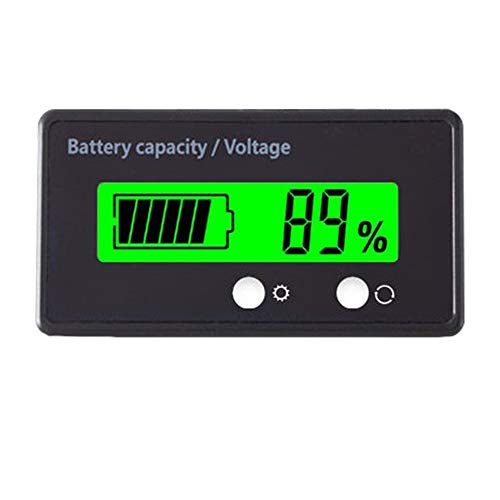
Universal battery capacity indicator voltage meter - wide voltage input range DC 12V-84V Lead-acid Batteries and 3S-26S Lithium Batteries: Ternary lithium batteries, polymer batteries, lithium-ion batteries, storage batteries.