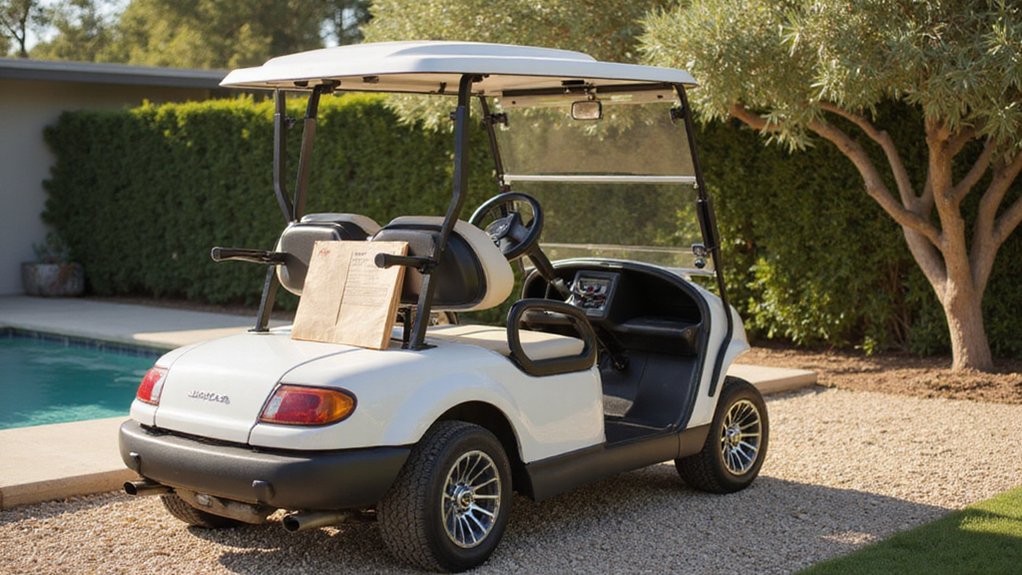
Wondering if your golf cart needs a title to hit the road? Typically, they don’t come with one straight from the factory, but converting yours for street use changes that.
Once you add headlights and mirrors, you’ll need to register and get a title, along with proof of insurance. Here’s what you need to know about the paperwork involved to keep everything legal.
When a Golf Cart Has a Title (and When It Doesn’t)
If your golf cart has a title, it’s usually because it has been converted into a street-legal low-speed vehicle (LSV). Untitled golf carts typically don’t come with a title because they are primarily built for private property use, like on golf courses or within gated communities. When a cart is used only on private property, ownership is proven through a signed bill of sale and matching serial numbers, eliminating the need for DMV paperwork. However, if you modify your golf cart to meet the requirements for street use—adding road equipment like headlights, turn signals, and mirrors—you then need to obtain a title. This process involves VIN verification, DMV registration, and insurance, which makes your cart officially a low-speed vehicle (LSV). Always check your state’s specific rules, because regulations vary: some states require a title immediately after the modification, while others may have different procedures or timelines. For example, ensuring your cart has a reliable 36 volt battery charger is essential for maintaining the power system needed to support street-legal modifications. Choosing a top deep cycle battery ensures your cart meets the electrical demands of street-legal upgrades. Understanding the average lifespan of these power sources can help you plan for replacements that keep your street-legal modifications operational.

48V105AH lithium battery
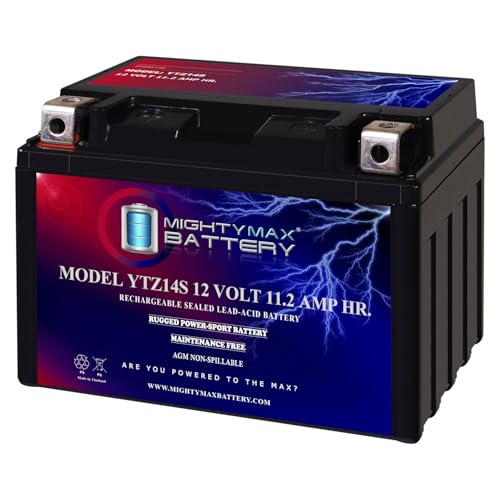
YTZ14S is a 12V 11.2AH 230 Cold Cranking Amps (CCA) Sealed Lead Acid (SLA) Battery

YTX14-BS is a 12V 12AH 200 Cold Cranking Amps (CCA) Sealed Lead Acid (SLA) Battery
3 Scenarios That Require a Golf Cart Title
You need a golf cart title in three main scenarios. The first is when you convert your golf cart to a street-legal low-speed vehicle (LSV). Once you upgrade your cart with the required safety features and any road-appropriate accessories, it becomes classified like a motor vehicle. Because of this, it must be registered and titled to operate legally on public roads. This process involves meeting specific state regulations that define what makes golf carts street legal, including safety equipment requirements for road use. Choosing the right tires with rims is also essential for safe road performance and meeting inspection standards. Unlike a UTV, which is often titled from the factory as an off-road vehicle, a golf cart may require additional steps for road legality classification.
The second scenario is if you are planning to finance the purchase. Lenders require a title to record a lien against the vehicle. Without a title, they cannot secure their interest, and you won’t qualify for a loan or financing.
The third situation involves using a golf cart for recreational purposes on public roads or reselling a titled cart. A bill of sale alone does not transfer ownership; you must go through your state’s title system to ensure clear ownership and avoid future legal issues.
Paperwork Needed When You Convert a Golf Cart for Street Use
To convert a golf cart for street use, you need to gather several key pieces of paperwork. Start with the manufacturer’s Certificate of Origin (MCO) or a bill of sale for the cart. You will also need to complete an application for a vehicle title, submit a builder’s statement detailing the modifications, and provide an affidavit confirming the cart has been converted into a low-speed vehicle. Documentation proving all conversion parts and safety equipment were installed, supported by original receipts, is essential to demonstrate legal compliance. Typically, a vehicle inspection, photographs of the converted cart, and a certified weight slip are required before applying for registration. You must also provide proof of insurance that meets your state’s minimum coverage standards. Although battery maintenance records are not part of the paperwork, proper documentation can help verify your conversion adheres to safety and legal standards. Understanding used golf cart prices can help you budget for the total cost of the conversion process. Submit all these documents, along with applicable fees, to your local motor vehicle or motorist services office to complete the process. For carts originally produced by certain manufacturers, you may need to confirm the specific manufacturing location to ensure the MCO matches your state’s import or title requirements. Registration requirements vary by state and community, so you should check your local Department of Motor Vehicles before starting the paperwork.

【ALL-IN-ONE LITHIUM UPGRADE KIT】: Includes everything for a hassle-free installation: 48V 102Ah LiFePO4 battery, charger, LCD display with stand, and straps. Built-in DC-DC converter powers 12V accessories (lights, horn, stereo)—no voltage reducer needed.

Grade A Cells: LOSSIGY 48 Volt lifepo4 lithium golf cart batteries are manufactured of auto grade-A cells with higher energy density, more stable performance&greater power.

HIGH-OUTPUT 72V 1500W POWER SYSTEM Experience superior performance with this advanced 72V 1500W brushless motor and controller combination, designed for enhanced speed, torque, and efficiency in demanding applications.
State-by-State: Title Rules in Florida, California, Texas, Mass
In Florida, you only need to title a golf cart after converting it into a low-speed vehicle. This process requires an inspection and assignment of a Vehicle Identification Number (VIN). Standard golf carts used exclusively on golf courses do not need a title. However, once you modify a cart for road use, you must go through the state’s titling process to ensure it meets compliance with road traffic regulations. Ensuring the cart has a reliable 24 volt battery charger can help maintain the vehicle’s compliance with operational standards during inspections.
California requires that all golf carts intended for on-road use be titled as street-legal vehicles. To do this, you need to submit a completed application and provide proof of ownership, such as a bill of sale or manufacturer certificate. If your cart is not classified as street-legal, you typically do not need a title unless you plan to drive it outside the golf course or private property. Once it becomes street-legal, then titling and registration are necessary to operate legally on public roads.
In Texas, standard golf carts do not require a title unless you modify them for street use. If you make such modifications like adding lights, turn signals, or license plates, the cart then becomes subject to title and registration procedures. This process involves paperwork and fees that confirm the vehicle’s legal status for road travel.
Massachusetts requires registration for golf carts that are used beyond golf course or private property, particularly for street or road use. To register, you need to provide receipts, manufacturer certificates, or proof of ownership. If you’re only using the cart on private property or golf courses, registration and titling are generally unnecessary. Moving onto public roads triggers the need for proper registration, making it important to keep documents updated and vehicles compliant with local laws.

【Upgraded Battery Charger】AUTOUTLET 8 volt battery charger extends the charging cable, adds a carrying handle to make it more convenience to use; and adopts the cable clamps of thickened material which can hold the battery terminals more firmly

DC 9V- 40V to DC 24V voltage reducer and booster: Input Voltage 12V/24V/36V nominal, accept 9V- 40V input range, Output Voltage DC 24V 6A 145W

30A 24V Fast & Efficient Charging: This upgraded intelligent charger is designed for vehicles with 24V lead-acid batteries, including forklifts, floor scrubbers, golf carts, electric pallet trucks, and sightseeing carts. Simply connect the battery, turn on the power switch, and the charger will automatically begin outputting current and voltage. It stops charging when the battery is full, offering faster charging speeds and higher efficiency
The 4 Documents Every Golf Cart Owner Should Keep
Keeping these four essential documents with your golf cart ensures you’re prepared for almost any situation. First, hold on to your proof of ownership, such as a bill of sale or Manufacturer’s Certificate of Origin that includes your cart’s serial number. This document proves ownership and is necessary if you need to transfer or register your cart. Reviews of top models can help you identify quality and performance standards before you buy. When selecting a solenoid for performance upgrades, check a review of heavy duty solenoids to ensure reliable switching under load.
Second, keep any title or registration paperwork, especially if you have made your cart street-legal. These documents verify that your vehicle complies with local laws and can be required during police stops or registration renewals. It’s best to keep digital backups as well as physical copies.
Third, store your insurance documents securely. They should match your cart’s Vehicle Identification Number (VIN) and specify liability coverage for on-road use. This ensures proof of coverage if you get into an accident or are asked by authorities.
Fourth, save all purchase, repair, and tax records related to your golf cart. Itemized receipts for upgrades like accessories or parts, along with repair invoices, can support warranty claims and verify modifications. For example, if you upgrade performance parts, referencing a review of top Club Car parts ensures you invest in reliable, compatible components. Pair these records with maintenance tips from your owner’s manual to keep your cart in top shape and protect your interests during resale. Always keep these papers in a safe, accessible location to avoid disputes or delays later on.

48V 4-Terminal Solenoid with Resistor for Club Car golf cart

36 Volt 4 terminal SPNO heavy-duty solenoid for EZGO TXT, Medalist, Marathon 1971-2010 electric golf cart

【Replacement For】1976-1998 36 Volt electric Club Car DS Golf Carts.
5 Steps to Check Title and Ownership Documents Before a Sale
To ensure a smooth transaction, you must verify ownership documents and title status before completing a golf cart sale. First, determine if a title is required—standard golf carts usually don’t need one, but if the cart is road-legal, a title is typically necessary. Second, compare the serial number or VIN on the cart with all paperwork; any discrepancies could indicate fraud. Third, review proof of ownership: a bill of sale for untitled carts or a signed title for titled ones. Fourth, search for liens against the cart using its serial number—just having a signed title doesn’t guarantee all claims are cleared, so checking for liens is vital. Fifth, familiarize yourself with your state’s transfer requirements, which often include notarization, proof of insurance, or sales tax. Missing any of this documentation can complicate or even derail your resale options later. Also, keep copies of all paperwork for future reference and maintenance records. To maximize long-term performance, consider upgrading to a lithium battery system, which offers better reliability and lower maintenance than traditional lead-acid batteries. For a cart that performs well, focusing on quality and performance during your initial selection can prevent future paperwork headaches. Additionally, you may want to inspect the condition of top hub caps to ensure they are secure and match the cart’s appearance, as this can also affect resale value.

Born for 48V Golf Cart: Special designed for 48v golf cart industry, OGRPHY 48v lithium golf cart battery is compatible with golf cart controllers of all major brands on the market. Built in premium grade A prismatic LiFePO4 cells(UL certified), this 48v battery has better durability & safety. Over 5kWh capacity equals 8pcs 12V 100AH lead acid batteries. Max 10.24kW continuous power & peak 51.2kW power (50% more powerful than standard lithium batteries) to conquer hills/rough terrain effortlessly.

[10 Years Lifetime and 5000+ Deep Cycles] OGRPHY 48 volt lithium battery is made of new grade A cells with UL certification. 10 years lifetime and 5000+ deep cycles is not just a slogan under instructions on the product manual.

Get Rid of Lead Acid Batteries Now: Revolutionize your golf cart with Lithova 48V golf cart lithium conversion kit! This 48V lithium battery directly replaces 6-8V 50Ah heavy lead-acid batteries in one simple installation. Enjoy 74% weight reduction, 60% smaller size, and extended 25-mile range (effortless 3-5 Rounds of 18-hole courses). Lasts 8x longer than lead-acid batteries, Up to 15000 deep cycles ensure maintenance-free performance and long-term reliability.