Figuring out the right air pressure for your golf cart tires can feel confusing, especially since it varies with terrain and tire size.
For standard 18×8.50-8 tires, 20 PSI is a good middle ground.
But you’ll need to adjust for other surfaces. Keep reading to find out how to set your tires just right for safety and performance.
What’s the Right PSI for Standard Golf Cart Tires? (Aim for 18–22 PSI)
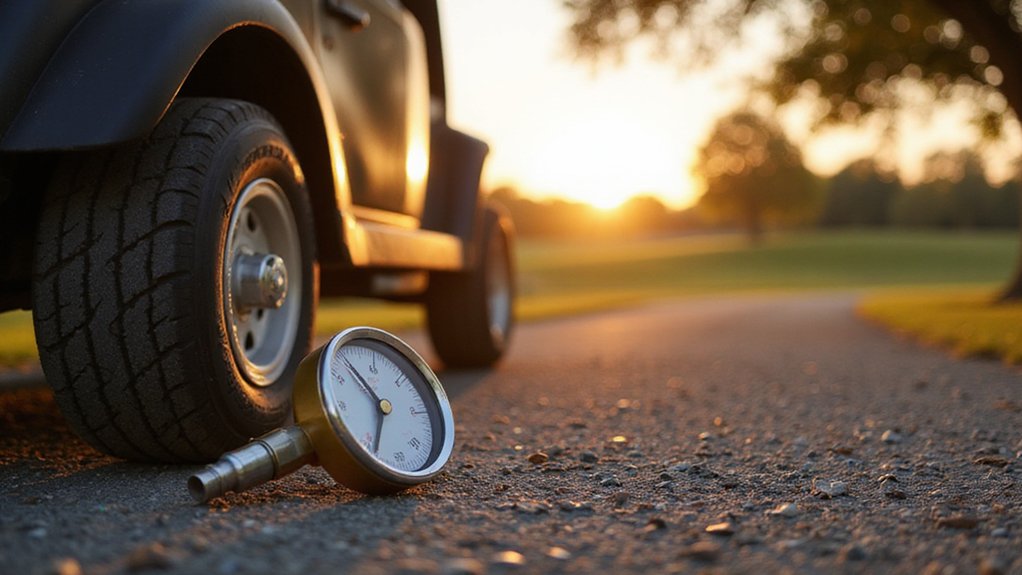
The ideal PSI for standard golf cart tires is between 18 and 22 PSI. This range ensures a good balance between ride comfort, tire longevity, and handling. Generally, for typical 18×8.50-8 tires, 22 PSI is considered the factory baseline, offering a firm yet comfortable ride. If you prefer a softer ride or are carrying lighter loads, lowering the pressure to around 18 PSI can improve comfort. When you don’t have specific guidance, 20 PSI serves as a safe middle ground. Always check tire pressure when the tires are cool, since driving heats up the air inside and increases PSI. Use a reliable pressure gauge and avoid guessing or relying solely on the tire sidewall max pressure, which isn’t meant for everyday inflation. Maintaining consistent pressure across all four tires helps prevent uneven wear and ensures smooth handling. For those seeking optimal quality and performance, proper tire pressure is a key factor that complements the overall capability of the cart. Refer to the sidewall of your tires and your owner’s manual for the most accurate PSI recommendations. For further protection from weather while checking your tires, a well-suited windshield for golf cart can keep you dry and focused. To keep your tires in top condition, consider storing your cart with a perfect ezgo golf cart cover to shield it from sun and moisture damage.
Accurate, Dependable Readings: Factory‑calibrated to ±1 PSI, so you can confidently match your vehicle’s recommended PSI (check the door jamb sticker). Ideal for monthly checks and road trips — consistent results every time, cold or warm.

PROCESS LEVEL ACCURACY: This heavy duty tire pressure gauge is calibrated manually to ANSI B40.1 Grade A (±1% of span)

1.1-20 PSI LOW PRESSURE: Accurately measure from 1-20 PSI with 1.5 PSI precision—essential for RO tank, Golf Carts, ATV, UTV Lawn Mower. Standard gauges (starting at 20 PSI) cannot achieve this, preventing underinflation damage and poor handling.
Does Your Tire Type or Terrain Change the PSI? Yes, Here’s How
Your tire pressure needs vary based on the tire type and terrain you drive on. While a standard 18–22 PSI works for many factory tires, certain conditions require adjustments. Material and tread depth influence how much pressure your tires need to perform optimally. For pavement or street driving, 20–24 PSI offers stable rolling and good fuel efficiency. When you drive on soft dirt or gravel, lowering pressure to 18–20 PSI increases the contact patch, enhancing traction. For sand, temporarily reduce pressure to 10–14 PSI to prevent the tire from sinking. Turf tires work best around 20 PSI to prevent grass damage, while all-terrain tires typically perform best at 18–20 PSI across mixed surfaces. Always check your tire’s sidewall for maximum and minimum pressure limits, and adjust based on your load and terrain. Remember, there’s no universal number—your specific driving conditions dictate the ideal PSI. Before heading out, factor in how you transport your cart, since load distribution on a truck bed can shift weight and require a slight pressure tweak to maintain stability. For added convenience, consider pairing the right pressure with the best accessories that improve your cart’s ride quality and tire maintenance. For larger groups, choosing a cart with four passenger capacity ensures your gear and passengers are properly balanced for consistent tire performance.

Set of 4: The 205/50-10 golf cart wheels feature a 60% carbon black compound for wear, corrosion, and aging resistance. The aluminum alloy forged wheels with classic five-spoke design support up to 675 lbs/306 kg for smooth and quiet rides

(4) STINGER 22x10.5-12" All Terrain tires (DOT Approved)

30-DAY RETURN POLICY/1-YEAR WARRANTY: If your order arrives and it’s not exactly what you want, you may return it within 30 days for a refund. We know that people sometimes order a part and then discover it’s not exactly the one they need for the repair. We understand and want to work with you. Just make sure the item is in its original packaging and in good condition free of damage. Outside of 30-days, we will replace it anytime within one year of your order.
Step-by-Step Guide to Checking Golf Cart Tire Pressure
To get an accurate reading, start with a reliable tire pressure gauge and park your golf cart on level ground with the engine off. Remove the valve cap from each tire, then clean any dirt or debris from the valve stem to ensure a proper seal. Check the tires when they are cold—wait at least three hours after driving—because heat from use temporarily raises the PSI. For consistent performance, the best controller for an EZGO golf cart also relies on proper tire pressure for optimal torque and speed. When selecting replacement options, consider that top tire models from leading brands offer enhanced durability and traction for Yamaha carts. Upgrading your Club Car with compatible accessories can further improve overall ride quality and handling.
Press the gauge straight onto the valve stem and hold it firmly until the hissing sound stops. Read the pressure immediately on the gauge. Compare each reading to your golf cart manufacturer’s recommended PSI. If a tire is low, add air in short bursts, then recheck to avoid over-inflation. If a tire is overinflated, press the center pin of the valve briefly to release a small amount of air, then recheck.
Repeat this process for all four tires, ensuring each is within the recommended range. Afterward, replace the valve caps securely. Incorporate this check into your regular maintenance routine—monthly is recommended—and recheck after long periods of storage or if you notice handling issues. Always observe safety precautions to prevent under- or over-inflation, which can impact safety and tire longevity.

Performance tested & calibrated accurate to ANSI standards (±1.5%), ensuring precise low PSI tire pressure readings without relying on batteries; designed for the low pressure tires on your ATV, UTV, dirt bike, tractor, or off-road vehicle
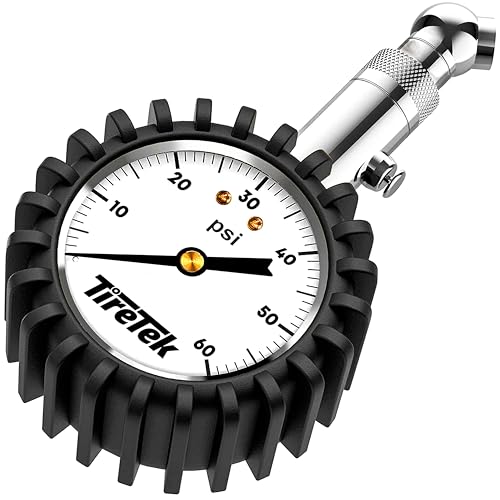
Professional Tire Pressure Gauge for Cars - This heavy duty mechanical tire pressure gauge is calibrated to ANSI B40.1 Grade B (2%) international accuracy standard so you get a precise, accurate pressure reading every time you use it. Makes great car accessories, car stuff, tire deflator, car stuff for men, cool car gadgets, car gifts for men, him, dad.

MECHANIC RECOMMENDED: Performance tested, certified & calibrated accurate to ANSI standards (±1.5%) at our industrial facility, ensuring precise tire pressure readings without relying on batteries.
What Happens When You Overinflate or Underinflate Golf Cart Tires?
Incorrect tire pressure negatively impacts your golf cart’s performance and safety. Overinflating your tires reduces their contact area with the ground, which means less traction on grass and pavement. You’ll notice a harsher, bouncier ride, and the center tread wears faster, cutting down your tires’ lifespan. Extremely high pressure also increases the risk of blowouts, especially during stress or rough terrain, making safety a concern. Adding a turn signal kit can further improve your cart’s safety and visibility on the road. For protective upgrades, consider that top hinge options can also secure your windshield against vibration damage. For even better handling, pairing proper tire pressure with an 8-inch wheel cover can help protect your wheels from debris and curb damage.
Underinflating causes the sidewalls to flex excessively, generating dangerous heat that can lead to failure. It makes steering sluggish and increases rolling resistance, requiring more effort to drive. Low pressure causes uneven wear, particularly on the outer tread edges, which shortens the life of your tires. It also raises the chances of sidewall damage, rim issues, and blowouts. You might also notice reduced braking efficiency and less stability, especially on wet or uneven surfaces. Maintaining the correct PSI helps prevent these hazards and ensures safer, smoother rides.

The WYNNsky tire gauge is designed specifically to provide precision measurements for low pressure readings that higher PSI gauges are unable to provide

Graduated 1-20 psi in 1/2 lb. increments

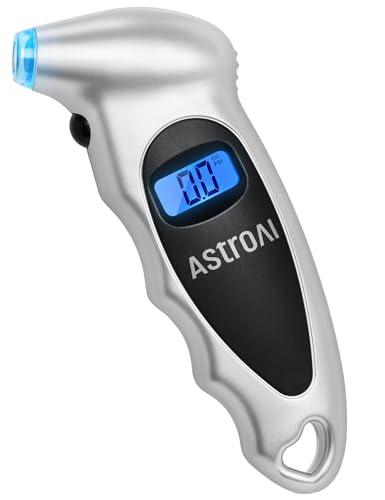
EXPERT-GRADE CALIBRATION: Each AstroAI Tire Pressure Gauge is calibrated with professional-grade tools, ensuring quick and accurate measurement results within plus-minus 1PSI. Stay prepared for any roadside emergency and travel with peace of mind.
PSI Chart: Common Golf Cart Tire Sizes and Uses
Matching tire pressure to your golf cart’s tire size and terrain is essential for optimal performance. For stock 18×8.50-8 tires, keep the pressure between 18 and 22 PSI when cold. This range enhances durability on both pavement and turf. Wider 18×9.50-8 tires utilize the same PSI range, which improves stability without sacrificing comfort. Upgrades to 20×10-8 tires also call for 18 to 22 PSI for a balanced mix of ride comfort and grip. Choosing the right windshield can also enhance your driving experience, and top windshield options for Yamaha carts are reviewed separately to ensure clear visibility on any terrain. Investing in a golf cart cover with heater can protect your cart and maintain comfort during cold weather use. For a secure fit, ensure your wheels use top lug nuts for golf cart to prevent loosening during driving.
Street-oriented 10-inch setups, such as 18×8.50-10 or 20×10-10, favor slightly higher pressure—around 20 to 24 PSI—delivering firmer handling suitable for paved surfaces. Lifted carts equipped with larger tires like 22×10-10 or 23×10-12 benefit from 18 to 20 PSI for all-terrain driving. For off-road use, reducing pressure to 12 to 18 PSI increases traction and minimizes tire damage on uneven surfaces.
Seasonal changes should also influence your pressure setting. In colder weather, slightly increase PSI to prevent tire sag. However, avoid overinflation, which can reduce grip and lead to a rougher ride. Always match your tire pressure closely to your specific tire size and terrain conditions to maximize safety and performance.

ALL-IN-ONE BUTTON CONTROL: One button does it all. The ETENWOLF T600 tire pressure gauge uses a single control to manually power the device on or off, reset the displayed reading to zero, and switch between PSI, BAR, and kPa—making tire pressure checks faster and easier without complicated controls.

PROCESS LEVEL ACCURACY: Each ETENWOLF’s digital tire pressure gauge is calibrated manually to ANSI B40.7 Grade 2A(plus-minus 1 PSI).Presta valve adapter not included, if used for bicycles, it must be purchased separately