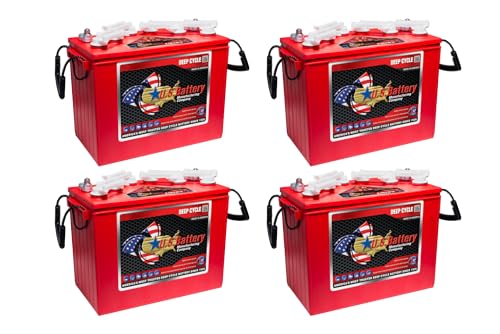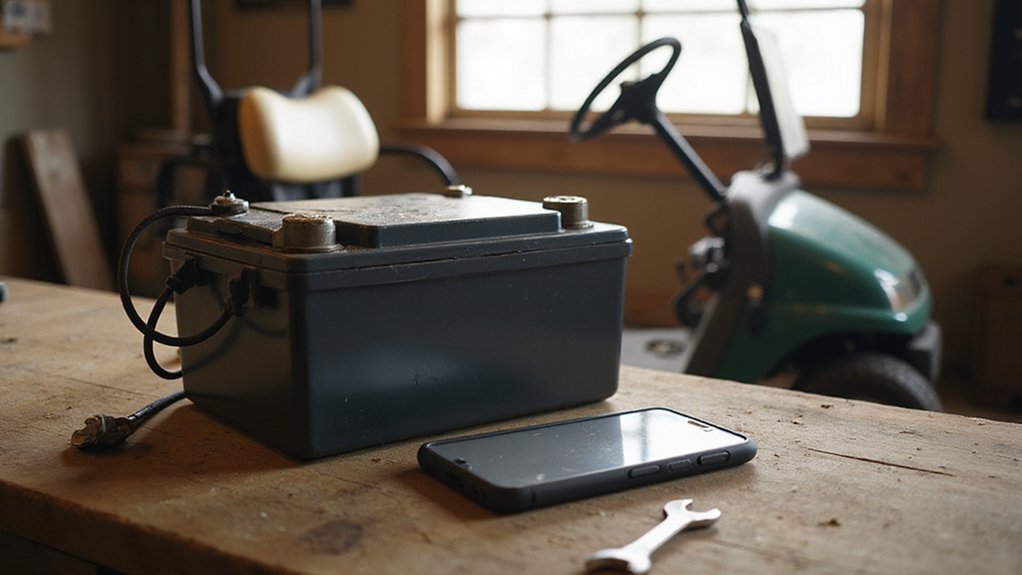
You might wonder if car batteries can power a golf cart. The short answer is no, they’re not designed for that purpose.
Car batteries aren’t built to handle the repeated deep discharges a golf cart requires and can fail quickly if used improperly.
Keep reading to learn why proper golf cart batteries matter and what you should consider for safe, reliable power.
Why Car Batteries Fail Golf Cart Voltage Matching
Car batteries fail in this context because they cannot provide the necessary voltage and current stability for golf carts. While a typical car battery delivers about 12 volts, golf carts often require 36V or 48V packs. You could wire multiple car batteries in series to meet that voltage, but their chemistry makes them unsuitable. Car batteries are designed for starting and quick energy bursts, not deep cycling. They lack the ability to maintain stable voltage under sustained, high-amperage loads. When you draw continuous power, their voltage drops significantly, leading to weak acceleration and errors in the controller. This mismatch can damage your motor and drivetrain. Additionally, a weak or failing battery in the pack drags down the overall performance and causes imbalance, making the entire system less reliable and more prone to failure. Unlike a dedicated golf cart battery, car batteries also lack the secure fender fit required to withstand the vibrations and terrain of a golf course. For example, top-rated golf cart tires are specifically designed to handle rough terrain and constant turf contact, whereas car batteries are not built for the sustained loads of a cart. For a reliable alternative, consider lithium battery options that are specifically designed for deep cycling and stable voltage delivery.

Effortless Hill Climbing: The 38.4V lithium golf cart battery delivers a 2C discharge rate, providing 100A continuous discharge and 150A peak current(30s). Climb hills effortlessly, take your golf game to the next level with reliable performance

LIGHTWEIGHT LITHIUM UPGRADE - Replace heavy lead-acid batteries with a 36V 105Ah LiFePO4 golf cart battery built for 36V systems. The lighter lithium design helps improve cart handling, acceleration, and hill-climbing performance while supporting a smoother on-course driving experience.and a battery life of 30-40 miles. Delivering a superior on-course experience.

POWERFUL PERFORMANCE: 36V (38.4V) 100Ah LiFePO4 Battery delivers 3840Wh energy, 200A continuous and 600A peak discharge. Provides stronger acceleration, reliable hill-climbing power, and extended range for golf carts and more. Please note: Charger not included.
Can You Use Car Batteries in a Golf Cart? (Short Answer: No)
No, you cannot use a car battery in a golf cart. The primary issue isn’t just voltage but the difference in battery chemistry and design. Car batteries are built for short, high-current bursts to start engines, whereas golf cart batteries are designed for deep cycling, providing slow, sustained power over time. This mismatch means the golf cart’s charging system, which expects a deep-cycle battery’s discharge and recharge profile, can’t properly manage a car battery. Choosing the right battery type is as important as selecting the best hinge for the windshield to ensure proper fit and durability. Using a car battery can lead to improper charging, potential damage to both the battery and the cart’s electrical system, and ultimately, reduced battery lifespan. For optimal handling with larger tires, a lift kit for club car is often compared to help find the right fit. For golf cart owners needing accessories, top roof racks are often compared to help find the right fit.
What Happens When a Car Battery Powers Your Golf Cart?
Repeated deep discharges can warp your car battery’s thin plates, reducing its lifespan by as much as 50 percent. This causes rapid capacity fade due to sulfation, where lead sulfate crystals build up on the plates and hinder performance. Additionally, a golf cart’s system is often incompatible with the car battery’s charging requirements. It can’t properly replenish the starter battery, leading to chronic undercharging. Over time, this results in frequent replacements and a cart that struggles to complete rounds efficiently, making it a costly and frustrating mistake. Using a proper charging sequence at home with the correct charger and voltage settings helps maintain battery health and prevent damage. Unlike a street legal golf cart, a standard golf cart’s electrical system is not designed to support the voltage and charging needs of an automotive starter battery. To confirm compatibility, you should first determine your golf cart’s model year by checking the serial number code.
Will Your Golf Cart Charger Work With Car Batteries?
No, a golf cart charger will not work with car batteries. Golf cart chargers are designed specifically for batteries with voltages of 36V or 48V. Car batteries, on the other hand, are typically 12V each. Connecting a 48V charger to a single 12V car battery can cause overcharging, which may damage the battery and create safety hazards. Even if you wire multiple car batteries together into a pack, the charger’s chemistry matters. Golf cart chargers use staged charging profiles tailored for lead-acid batteries of a specific chemistry. For example, Top Golf Cart Battery Chargers for Ezgo models are optimized for deep-cycle batteries, not the starting batteries used in cars. Mismatched chemistry, such as using a golf cart charger on car batteries, can lead to undercharging, overcharging, or battery failure. Therefore, it’s essential to match both the total pack voltage and battery chemistry to ensure safe and effective charging—car batteries are not compatible with golf cart chargers. Unlike car batteries, golf cart batteries are built as deep-cycle batteries to endure repeated discharges and recharges without damage. For transporting these heavy battery packs, consider using golf cart ramps for trucks to safely load and unload your equipment.

UNLEASH PEAK POWER: A 100-amp engine start and 12-amp to 30-amp boost charge bring dead batteries back to life fast, so your daily driver, truck, or weekend ride fires up the second you need it.

Efficient, Energy-Saving, and Fast Charging: The TowerTop 12v battery charger offers 4 adjustable current settings (2A/10A/25A/AUTO) to meet your diverse needs. With a max charging current of 25A, you can fully charge a 100Ah battery in under 3.5 hours. Achieving an 85% charging efficiency (industry average 75%), this battery chargers is more efficient, increasing charging speed by 1640% compared to 2A car battery charger. Not only is it energy-efficient, but it also saves you a lot of wait time
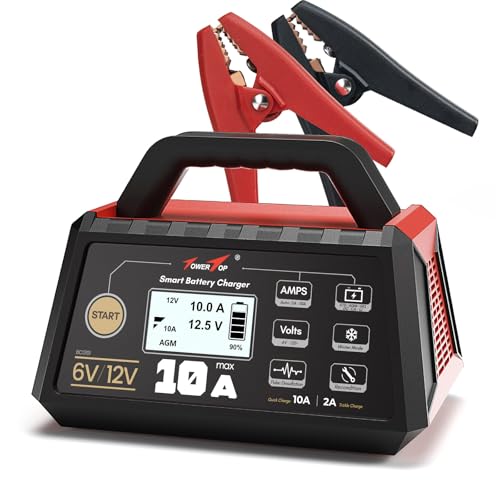
Efficient, Energy-Saving, and Fast Charging: The TowerTop trickle charger offers 3 adjustable current settings (2A/10A/AUTO) to meet your diverse needs. The max current is 10 amp, which can fully charge a 25Ah battery in just 2 hours. Compared to a 2A car battery charger, charging speed is increased by 647%. Not only is it energy-saving, but it also saves you a significant amount of waiting time
Best Golf Cart Battery Options: Why Car Batteries Won’t Work
Car batteries are not suitable for golf carts despite sharing a 12V rating. They are designed to deliver short, high-current bursts, which creates a capacity mismatch when used for continuous operation. Your golf cart requires a battery that provides steady, sustained power; using a car battery results in rapid drainage, weak acceleration, and limited range. For reference, a gas motor for an EZGO golf cart can offer sustained performance, but a battery mismatch will still hinder any electric system. Repeated deep discharging further damages car batteries, reducing their lifespan to just 30–50 cycles and causing permanent capacity loss of 30–50 percent. Instead, opt for deep-cycle lead-acid batteries with thicker plates and capacities of 150–250Ah, or consider lithium-ion alternatives for extended lifespan and efficiency. For a reliable upgrade, models like Trojan deep-cycle batteries are specifically engineered to handle the constant traction load without warping or sulfation, ensuring reliable performance and safety. Always follow a proper safety walkthrough to avoid electric shock and acid spills during installation.

Leoch Deep Cycle Golf Cart Battery – 6-volt sealed lead-acid battery designed for deep-cycle performance in golf carts and electric utility vehicles.

BCI Group Classification: GC2 battery group size for compatibility with golf carts and various deep cycle applications