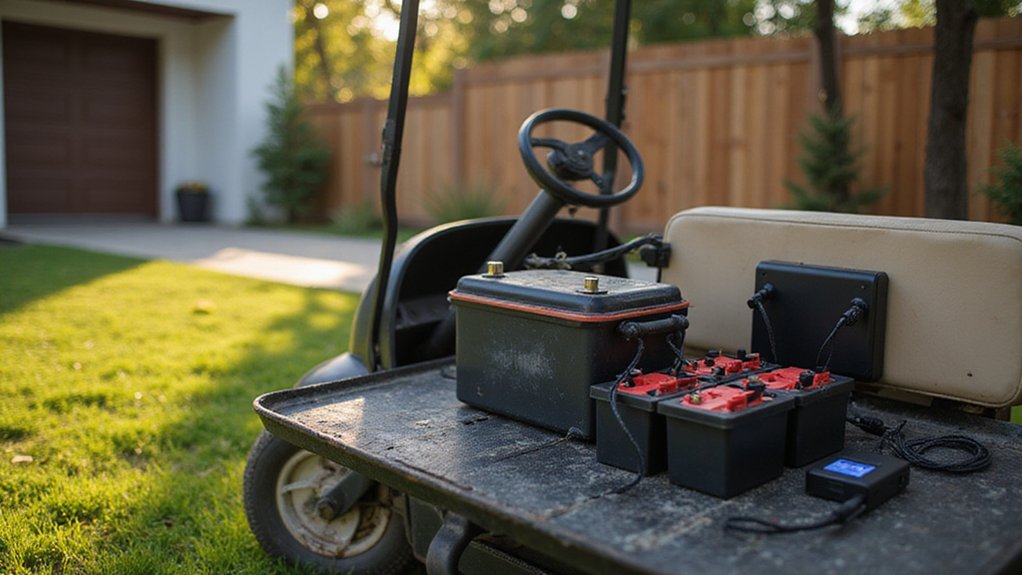
Wondering how to charge your 8-volt golf cart batteries safely and effectively? Knowing the right steps can extend your batteries’ lifespan and keep your cart running smoothly.
By understanding proper charging procedures and monitoring voltage levels, you can avoid damage and get the most out of your batteries.
Here’s a straightforward guide to help you do just that.
Choose the Right Charger for Your 8 Volt Golf Cart Batteries
Choosing the correct charger for your 8-volt golf cart batteries is essential to ensure proper battery health and longevity. First, verify that your batteries are lead-acid types, such as flooded, AGM, or gel, since lithium batteries require different chargers. The charger you select must match your battery configuration: use an 8-volt charger for a single battery or a 48-volt charger for a full series pack. A smart charger like the AUTOUTLET model automatically detects whether the battery requires 12-volt or 24-volt charging while also supporting various manual voltage options. A smart charger with automatic shutoff is advantageous because it prevents overcharging, which can damage your batteries. When selecting a cover to protect your cart and charger setup, a breathable waterproof cover is ideal for outdoor storage. Multi-stage chargers are preferred as they support healthier battery maintenance by adjusting the current through bulk, absorption, and float phases. Keep the charging amperage around 5 to 10 amps to avoid stressing the cells, especially during regular maintenance cycles. For those seeking the highest performance, reviewing reviews of top lithium golf carts can help compare quality and performance alternatives. If you are considering upgrading to a lithium system, looking at best lithium battery chargers can provide valuable guidance on advanced charging options. Always choose a charger explicitly labeled for 8-volt batteries and deep-cycle use to ensure compatibility and optimal performance. Proper matching of charger and batteries leads to longer battery life and more reliable golf cart operation.

ONE CHARGER FOR MULTIPLE VOLTAGES – This ALLmeter smart battery charger automatically supports 6V, 8V, 12V, 24V, 36V and 48V lead-acid batteries with charging current up to 12A. Use it as an 8V battery charger, 12V charger, 24V charger, 36V charger or 48V battery charger for cars, motorcycles, golf carts, RVs, marine batteries and other compatible equipment.

Smart Charging:Ultrapower smart battery charger is designed for charging 14.6 Volt LiFePO4 batteries.built in intelligent charging management unit,fully automatic charging and CUT-OFF,detects the battery status and effectively activate "0"V battery.safely wake up BMS-protected battery
Set Up Your Cart for Charging 8 Volt Batteries Safely
To set up your cart for charging 8-volt batteries safely, start by creating a secure, well-ventilated area. Ideally, choose an outdoor space or an open garage with doors fully open to allow hydrogen gases to disperse. Turn off the cart completely by switching off the ignition and removing the key—this prevents accidental starting during charging.
Next, inspect all batteries, cables, and terminals for cracks, corrosion, or any damage. Ensure flooded batteries have electrolyte levels covering the plates. Never attempt to charge damaged or frozen batteries, as they pose safety risks. If a battery has been recently heated or is hot, allow it to cool first. Clean any dirt or debris around the terminals to ensure proper electrical connections. Choosing the perfect golf cart enclosure can also help protect your battery setup from weather-related damage during storage. For transporting your cart to a service location, a top-rated golf cart trailer ensures safety and stability. Selecting a high-quality Yamaha battery set from the guide ensures compatibility and reliable performance.
Keep any flames, sparks, or smoking materials away from the charging area. Wear protective gloves and safety glasses throughout the process. Confirm that your battery pack’s wiring and total voltage are compatible with your charger and the cart’s specifications. Use a stable, flat, and dry surface to place the cart; this reduces the risk of shock and prevents damage to the batteries. Following these steps helps ensure a safe and effective charging process.
Connect the Charger Correctly (Step by Step)
To connect the charger correctly, start by locating the charging receptacle or battery pack terminals—don’t guess if a dedicated port exists. Match the red lead to the main positive terminal and the black lead to the main negative. Incorrect polarity can damage your equipment, so double-check those polarity marks before making the connection. Before proceeding, consider testing the charger safely to verify its output voltage. Be aware that typical charge times vary by pack voltage and battery chemistry, so consulting your charger’s manual helps avoid overcharging. If you are using a cart from a brand like Bintelli, note that its factory wiring is designed for consistent polarity across all battery configurations.
Make the connection firmly by inserting the plug fully and straight, avoiding any twisting or forcing. If you are using clamp leads, ensure each clamp seats securely on the correct terminal and check that the cable insulation isn’t frayed or damaged. Always connect the charger to the cart first, then plug it into the wall outlet. This sequence helps reduce arcing and improves safety.
Finally, verify that the charger’s indicator light or display activates. If it doesn’t, recheck the polarity and ensure the plug is fully engaged. Properly connecting the charger supports better battery maintenance and helps prevent costly mistakes.

【Upgraded Battery Charger】AUTOUTLET 8 volt battery charger extends the charging cable, adds a carrying handle to make it more convenience to use; and adopts the cable clamps of thickened material which can hold the battery terminals more firmly

【Upgraded Battery Charger】AUTOUTLET 8 volt battery charger extends the charging cable, adds a carrying handle to make it more convenience to use; and adopts the cable clamps of thickened material which can hold the battery terminals more firmly

SMART MULTI-VOLTAGE UNIVERSAL BATTERY CHARGER – The All-in-One Power Solution for Every Lead-Acid Battery. This intelligent automatic charger seamlessly adapts to 6V, 8V, 12V, 14V, 16V, and 24V batteries, offering extensive compatibility with virtually all lead-acid batteries, including WET, MF, CA, AGM, GEL, SLE, VRLA, EFB, and STD. Featuring fully automatic charging current from 0 to a maximum of 15A, it delivers rapid, customized power for everything from routine maintenance to emergency charging—ensuring your battery receives the precise charge it needs.
Use the Correct Voltage and Monitor the Charge Cycle
After connecting your charger, it’s essential to use the correct voltage and closely monitor the charge cycle. For an 8V battery, aim for an on-charge voltage around 9.2 to 9.6V. Make sure your charger matches the total pack voltage — for example, a 48V battery pack requires a 48V charger. During the bulk, absorption, and finish stages, verify the voltage with a multimeter for accurate readings. Mid-charge, you should see voltage levels between 9.0 and 9.8V. If the voltage stays below 8.2V after charging, this can indicate battery aging or sulfation. Monitoring the current is equally important; watch for it to drop to zero, which signifies the cycle has completed. Do not rely solely on surface charge; always check the rested voltage after allowing the battery to sit for a bit. A resting voltage of around 8.4 to 8.5V indicates a full charge. Persistent low voltage measurements suggest declining battery health rather than just a discharge. Understanding used golf cart prices and savings can help you budget for a replacement pack if needed. For longer battery life, consider upgrading to a lithium golf cart battery, which often provides more consistent voltage readings. For additional protection during charging, using a high-quality golf cart cover can shield your cart from the elements and extend battery reliability.

SAFE & RELIABLE: Smart circuits engineered with Digital Display, Automatic Shutdown design and Multilevel Protections guard against Overcharge, Over-Voltage, Overheat, Over-time Charging and Short Circuit, with intuitive Reverse Polarity LED Indicator. Spark proof during lead connection

BUILT FOR 8 VOLT GOLF CART BATTERIES – Designed as an 8 volt battery charger for charging and maintaining single 8V lead-acid batteries commonly used in EZGO, Club Car, Yamaha, and other golf carts. This 8V golf cart battery charger also supports 6V/12V/14V/16V/24V AGM, Gel, and standard lead-acid batteries for motorcycles, boats, RVs, ATVs, tractors, and more.

【15 Amp Rapid Charger/Lead-Acid】 EPOWREY 48 volt battery charger for Club Car golf carts with 3-pin round plug.This charger is designed as a one-piece plug, using a rubber cord that is more abrasion-resistant and heat-resistant than PVC cords, and have effective waterproofing advantage.
Avoid These Common Mistakes and Extend Battery Life
To extend your golf cart battery life, avoid the common mistakes of leaving lead-acid batteries discharged, overcharging, undercharging, or using interrupted charge cycles. Always recharge after every use to help prevent sulfation, which reduces battery capacity over time. Never let the battery pack sit discharged for days, as prolonged discharging damages the cells and shortens lifespan. Overheating caused by overcharging or stress from undercharging can harm the battery’s internal structure, so it’s essential to always complete a full charge cycle. Prioritize charging safety by using the correct charger specified for your batteries and avoid exposing the pack to extreme heat above 120°F, which can accelerate deterioration. Always wear safety goggles when checking or maintaining battery connections to protect against acid splashes. Additionally, use a timer to avoid overcharging if your charger lacks an automatic shutoff feature. For example, keeping batteries at a lower voltage during charging helps prevent overheating and aligns with consistent power management found in electric golf cart drivetrains.
Handle watering carefully: use distilled water only, water after charging, and avoid overfilling each cell. Do not mix old and new batteries; replace them as a matched set to ensure consistent performance. Keep all connections clean, tight, and free of corrosion to prevent poor electrical contact and performance issues. Consistent maintenance includes monitoring charge gauges, avoiding partial-state storage, and checking for signs of sulfation or corrosion. Regular upkeep like these significantly slows down battery wear and extends your overall battery lifespan.

Works with any rechargeable battery-powered equipment that charges from a standard wall outlet: e-bikes, e-scooters, jump starters, electric-start generators, portable power stations, cordless power tools, marine batteries, RV batteries, motorcycle batteries, lawn tractors, drones, trail cameras, two-way radios, cordless vacuums, and more. If it has a rechargeable battery and charges from a wall outlet, Charge-O-Matic can automate it.

【Designed Specifically for Yamaha G19 & G22 Golf Carts】This 48V golf cart battery charger delivers a stable 48V 15A (750W) output and features a dedicated 2-Pin “Binocular” plug, engineered exclusively for Yamaha G19 and G22 lead-acid battery systems—no adapters required.

Designed for EZGO TXT 36V Lead-Acid Battery Systems — Compatible with Powerwise connectors, this charger supports AGM, GEL, and Flooded lead-acid batteries. Suitable for daily course rounds, community commuting, and property maintenance.