You already know your Yamaha golf cart can go the distance, but finding a battery that actually keeps it running longer takes more than a quick search. Whether you’re tired of lead acid weight or want faster charging, the right lithium upgrade transforms your ride. Here are eight top options, starting with the feature rich ELEFAST 100AH 48V kit that includes Bluetooth monitoring and a 200A BMS.
| ELEFAST 100AH 48V Lithium Battery Golf Cart Kit with 200A BMS & Bluetooth |  | Best Overall | Battery Voltage: 48V (51.2V nominal) | Capacity: 100Ah (5.12kWh) | BMS Continuous/Peak Discharge: 200A continuous | VIEW LATEST PRICE | Read Our Analysis |
| TEMGO 48V (51.2V) 100Ah LiFePO4 Lithium Golf Cart Battery |  | Best Value | Battery Voltage: 48V (51.2V nominal) | Capacity: 100Ah (5.12kWh) | BMS Continuous/Peak Discharge: 200A continuous / 600A peak (3s) | VIEW LATEST PRICE | Read Our Analysis |
| 36V Lithium Golf Cart Battery Kit with 25A Charger & Touch Monitor |  | Longest Lifespan | Battery Voltage: 36V | Capacity: 105Ah (4.03kWh) | BMS Continuous/Peak Discharge: 200A continuous / 1000A peak | VIEW LATEST PRICE | Read Our Analysis |
| DC HOUSE Metal Case 48V 100Ah Lithium Golf Cart Battery Kit w/ 18A Charger |  | Most Durable | Battery Voltage: 48V | Capacity: 100Ah (5.12kWh) | BMS Continuous/Peak Discharge: 200A continuous / 670A peak (0.5s) | VIEW LATEST PRICE | Read Our Analysis |
| TEMGO 36V (38.4V) 100Ah LiFePO4 Lithium Golf Cart Battery |  | Lightest Option | Battery Voltage: 36V (38.4V nominal) | Capacity: 100Ah (3.84kWh) | BMS Continuous/Peak Discharge: 200A continuous / 600A peak (3s) | VIEW LATEST PRICE | Read Our Analysis |
| LOSSIGY 48V Lithium Battery Golf Cart Conversion Kit with Charger&Monitor |  | Easiest Installation | Battery Voltage: 48V (51.2V nominal) | Capacity: 100Ah (5.12kWh) | BMS Continuous/Peak Discharge: 200A continuous / 1000A peak (3-5s) | VIEW LATEST PRICE | Read Our Analysis |
| 48V 100Ah Lithium Golf Cart Battery 4 Pack 12V 100Ah LiFePO4 Solar Battery |  | Most Versatile | Battery Voltage: 48V (4×12V in series) | Capacity: 100Ah total (4×100Ah) | BMS Continuous/Peak Discharge: 100A continuous / 200A peak (3-5s) | VIEW LATEST PRICE | Read Our Analysis |
| 48V 105Ah Lithium Golf Cart Battery with 250A Smart BMS | 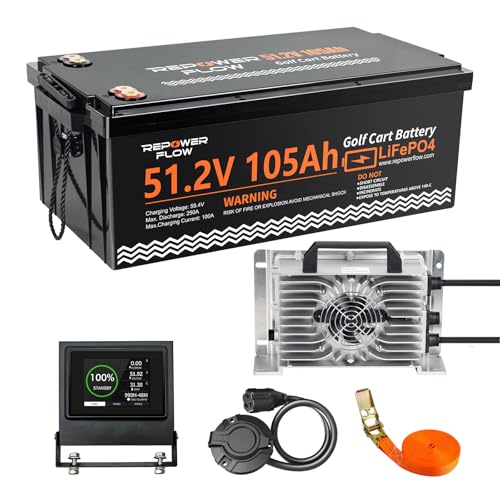 | Highest Capacity | Battery Voltage: 48V (51.2V nominal) | Capacity: 105Ah (5.38kWh) | BMS Continuous/Peak Discharge: 250A continuous / 400A peak (3s) | VIEW LATEST PRICE | Read Our Analysis |
More Details on Our Top Picks
ELEFAST 100AH 48V Lithium Battery Golf Cart Kit with 200A BMS & Bluetooth
If you’re after a battery that delivers more power per charge without the bulk, the ELEFAST 100AH 48V kit stands out as your top pick for overall value.
It packs 5.12kWh of energy, giving you 15% more juice than similar lithium options. Weighing just 82.89 lbs, you can install it solo thanks to its compact, drop-resistant plastic casing. The built-in 200A smart BMS prevents overcharging and short circuits, while Bluetooth lets you monitor status on your phone. You’ll get up to 40 miles per charge, and the included 58.4V 18A charger tops it off in five hours flat.
- Battery Voltage:48V (51.2V nominal)
- Capacity:100Ah (5.12kWh)
- BMS Continuous/Peak Discharge:200A continuous
- Cycle Life:6,000 cycles
- Weight:82.89 lbs
- Warranty:5 years
- Additional Feature:58.4V 18A fast charger
- Additional Feature:606 feet mounting straps
- Additional Feature:5-year warranty coverage
TEMGO 48V (51.2V) 100Ah LiFePO4 Lithium Golf Cart Battery
Start with TEMGO’s 48V (51.2V) 100Ah LiFePO4 battery if you want serious longevity without breaking the bank. You’re getting over 5000 deep cycles at 80% DOD, which beats lead-acid ten times over. The 200A continuous discharge (600A peak for 3 seconds) delivers the punch your cart needs.
Your monitoring options are solid. Use the 2.8-inch LCD touch screen or check the Bluetooth app for real time data. The 200A Smart BMS protects against overcharging, overdischarging, short circuits, and temperature extremes. It even scales up to four units for 20.48kWh total. Just remember, it’s not compatible with carts using CAN communication protocols.
- Battery Voltage:48V (51.2V nominal)
- Capacity:100Ah (5.12kWh)
- BMS Continuous/Peak Discharge:200A continuous / 600A peak (3s)
- Cycle Life:5,000+ cycles (80% DOD)
- Weight:61.7 lbs
- Warranty:1 year
- Additional Feature:58.4V 18A charger included
- Additional Feature:2.8-inch LCD touch display
- Additional Feature:Supports up to 4 units
36V Lithium Golf Cart Battery Kit with 25A Charger & Touch Monitor
For unmatched longevity in your Yamaha golf cart, the 36V Lithium Golf Cart Battery Kit with 25A Charger & Touch Monitor is your best bet. You’re getting 12 grade LiFePO4 cells paired with a 200A BMS that delivers 7.68kW of instant power, perfect for steep hills and sudden acceleration. With over 8,000 cycles, it’ll last more than ten years. That’s 70% less cost than lead-acid over time.
- Charging: The 43.8V 25A fast charger takes you from 50% to full in about 2 hours.
- Range: Expect 50 miles on a 3kW motor, enough for multiple 18-hole rounds.
- Installation: No special wiring needed. It weighs just 70 pounds, much lighter than alternatives.
- Safety: It’s leak proof, explosion proof, and protects against overcharge, overdischarge, and short circuits.
Just remember to disconnect the Bluetooth and turn off the touch monitor when not in use, and always charge when you’ve got at least 15% remaining. You’ll also get a 5 year warranty and 24/7 support.
- Battery Voltage:36V
- Capacity:105Ah (4.03kWh)
- BMS Continuous/Peak Discharge:200A continuous / 1000A peak
- Cycle Life:8,000+ cycles
- Weight:~70 lbs
- Warranty:5 years
- Additional Feature:43.8V 25A fast charger
- Additional Feature:Over 8,000 charge cycles
- Additional Feature:Leak-proof and explosion-proof
DC HOUSE Metal Case 48V 100Ah Lithium Golf Cart Battery Kit w/ 18A Charger
The DC HOUSE Metal Case 48V 100Ah Lithium Golf Cart Battery Kit is the most durable option for golfers who want a near‑lifelong upgrade without the weight of lead‑acid. It drops right in for 6-8V 100Ah setups, no wiring hassles. You get a compact, fireproof metal case with a safety switch and vent, plus Grade A cells that resist swelling.
Expect up to 56 miles per charge, covering 7-9 rounds easily. The 48V 18A charger powers it fully in about 5.5 hours, with auto-stop for peace of mind. A 200A BMS handles low-temperature cutoffs and six key protections. You can Bluetooth monitor your battery’s status via app. Three-year warranty with US support backs it all up.
- Battery Voltage:48V
- Capacity:100Ah (5.12kWh)
- BMS Continuous/Peak Discharge:200A continuous / 670A peak (0.5s)
- Cycle Life:Not specified
- Weight:Not specified (74% lighter than lead-acid)
- Warranty:3 years
- Additional Feature:Fireproof metal casing
- Additional Feature:One-key safety switch
- Additional Feature:Reserved communication port
TEMGO 36V (38.4V) 100Ah LiFePO4 Lithium Golf Cart Battery
Your upgrade search ends here if you want the lightest option for your Yamaha cart. At just 61.7 pounds, the TEMGO lithium battery slashes weight by over 100 pounds compared to lead acid. You get a complete all in one kit: a 42.6V 20A charger, an LCD touch display, and a retention strap. The 200A smart BMS protects against overcharge, short circuits, and temperature extremes. Plus, you can monitor everything via Bluetooth or the 2.8 inch screen. With over 5000 deep cycles, you’ll likely never replace this battery again. It even supports up to four units in parallel for expanded capacity.
- Battery Voltage:36V (38.4V nominal)
- Capacity:100Ah (3.84kWh)
- BMS Continuous/Peak Discharge:200A continuous / 600A peak (3s)
- Cycle Life:5,000+ cycles (80% DOD)
- Weight:61.7 lbs
- Warranty:Not specified (manufacturer warranty)
- Additional Feature:42.6V 20A charger included
- Additional Feature:M8 automotive-grade terminals
- Additional Feature:Supports up to 4 units
LOSSIGY 48V Lithium Battery Golf Cart Conversion Kit with Charger&Monitor
Losing power mid round is frustrating, but this Lossigy conversion kit makes the switch to lithium as close to plug and play as possible. You’re getting Grade A LiFePO4 cells with a 100Ah capacity and 51.2V nominal voltage, so it’s ready for your Yamaha, RV, or even a truck. The built-in BMS has your back against shorts, overloads, and temperature extremes from -4°F to 140°F. Plus, it’s IP65 rated for dust and water resistance.
- Longevity: Lasts over 4000 cycles or 10 years.
- Flexibility: Parallel up to four units for 400Ah total.
- Included: Charger and monitor come with it.
- Support: 5 year warranty and 24/7 tech help.
You’re looking at roughly 20.5 x 10.6 x 8.7 inches and 83 pounds. Screw terminals make wiring straightforward. It’s a solid, worry free upgrade!
- Battery Voltage:48V (51.2V nominal)
- Capacity:100Ah (5.12kWh)
- BMS Continuous/Peak Discharge:200A continuous / 1000A peak (3-5s)
- Cycle Life:4,000+ cycles (10+ years)
- Weight:82.9 lbs
- Warranty:5 years
- Additional Feature:IP65 waterproof rating
- Additional Feature:Removable M8 stud terminals
- Additional Feature:90-day worry-free service
48V 100Ah Lithium Golf Cart Battery 4 Pack 12V 100Ah LiFePO4 Solar Battery
Need a powerhouse that keeps your Yamaha cart rolling on long rides and overnight campouts? This 48V 100Ah system comes as a 4 pack of 12V 100Ah LiFePO4 batteries. Each unit measures 12.91 x 6.77 x 8.44 inches. You get 5120Wh total energy, and you can connect them in series for 48V or parallel for up to 400Ah. That’s a max of 20.48kWh. The Grade-A cells have an upgraded 100A BMS that protects against overcharging, overheating, and short circuits. It’s IP65 rated, so rain won’t stop you.
Performance is outstanding. You’ll see over 15,000 deep cycles at 60% depth of discharge, giving you about 10 years of use. It operates from -20°C to 60°C with low-temperature cut-off. Discharge hits 100A continuous, with 200A peaks for 3 to 5 seconds. Charge it fast using 14.6V and under 50A. Need to store it? Recharge every 3 to 5 months. Installation is easy with M8 terminals, and the whole pack weighs only 23 pounds. You also get a 5 year warranty.
- Battery Voltage:48V (4×12V in series)
- Capacity:100Ah total (4×100Ah)
- BMS Continuous/Peak Discharge:100A continuous / 200A peak (3-5s)
- Cycle Life:15,000+ cycles (60% DOD)
- Weight:~23 lbs per battery (92 lbs total)
- Warranty:5 years
- Additional Feature:IP65 waterproof rating
- Additional Feature:Series/parallel connection
- Additional Feature:15,000+ deep cycles
48V 105Ah Lithium Golf Cart Battery with 250A Smart BMS
If you want the highest capacity in this lineup, the 48V 105Ah lithium battery from Repower Flow is the clear winner. You get 5376Wh from LiFePO4 cells, delivering over 6000 deep cycles at 80% depth of discharge. That’s reliable performance for 10+ years, no watering required.
A built-in 250A Smart BMS protects against overcharge, overcurrent, and short circuits. Fast charge it in about 5.5 hours with the included 20A charger. You’ll monitor everything on the 2.8-inch touch screen or Bluetooth app. At just 86 pounds, it’s roughly half the weight of lead acid. Plus, dual terminals make series or parallel setups a breeze.
- Battery Voltage:48V (51.2V nominal)
- Capacity:105Ah (5.38kWh)
- BMS Continuous/Peak Discharge:250A continuous / 400A peak (3s)
- Cycle Life:6,000+ cycles (80% DOD)
- Weight:86 lbs
- Warranty:5 years (battery), 3 years (accessories)
- Additional Feature:250A Smart BMS
- Additional Feature:20A lithium smart charger
- Additional Feature:Dual terminal connections
Factors to Consider When Choosing Batteries for Yamaha Golf Cart
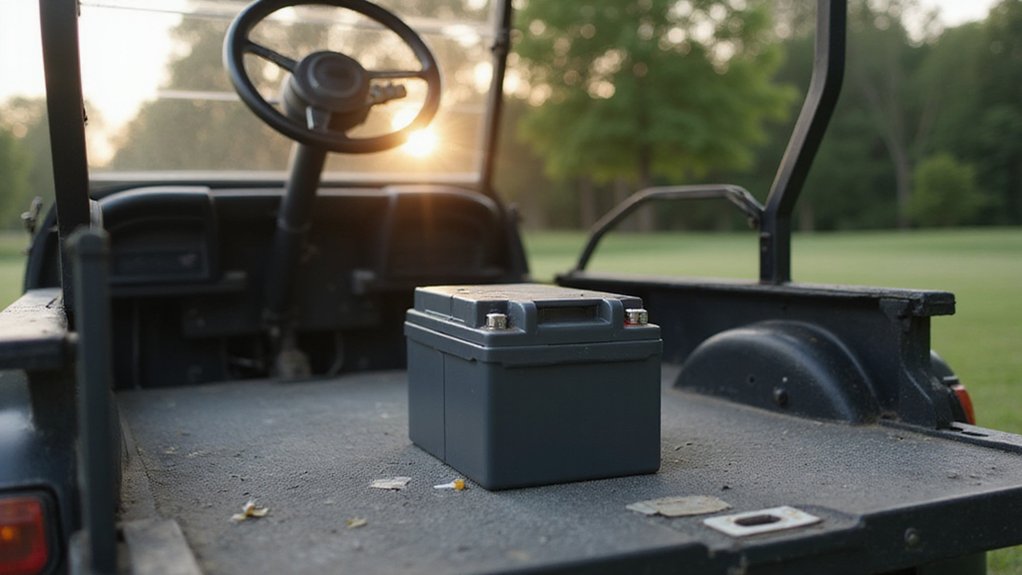
When you’re picking a new battery for your Yamaha golf cart, voltage compatibility is your first stop. You’ll also need to think about capacity requirements, or how far you want to go on a single charge, plus the battery chemistry type, physical fit dimensions, and BMS protection features. And don’t forget, a smart BMS keeps your battery safe from overcharging and excessive drain, so you get the longest life possible.
Voltage Compatibility
One of the first things you’ve got to nail when picking a new battery for your Yamaha golf cart is voltage compatibility. You need to match the original system, whether it’s a classic 36V or a more modern 48V. Using a battery with a higher or lower voltage? That’s a quick way to fry your cart’s electrical guts or kill performance dead. So, always check the battery’s nominal voltage. Some lithium batteries get labeled oddly, but they still need to line up perfectly with your cart’s design. For instance, if your Yamaha runs a 48V system, grab a compatible 48V battery. That choice keeps power smooth and efficiency high. And don’t forget: any voltage conversion you attempt can void warranties or mess with safety features. Stay true to the original spec, and you’re golden.
Capacity Requirements
Before you settle on a battery, you’ve got to think about capacity requirements—how much energy you’ll actually need to get around the course. Capacity is measured in amp-hours (Ah), and it directly determines your driving range. For a typical round, you’ll often want between 100Ah and 200Ah. Don’t guess: calculate the distance you usually travel. A higher capacity battery lets you play longer before recharging, but it also adds weight and cost. You’ll need to match the battery’s capacity with your cart’s power consumption. Go too low, and you’ll face underperformance. Go too high, and you’ll deal with unnecessarily long charging times. Upgrading to a larger capacity can boost overall performance, just be ready for the extra heft. It’s a trade-off, but getting it right keeps your ride smooth.
Battery Chemistry Type
The capacity you pick sets your range, but the chemistry underneath decides how long the pack lasts and how it behaves day to day. For your Yamaha, you’ve got two main roads: lead-acid and lithium-ion.
Lead-acid is your budget-friendly starter. It’s cheaper upfront, but you’ll pay with maintenance. You’ll need to water and equalize those cells regularly, and they’ll probably fade after a few seasons. That’s just the tradeoff.
But if you want a powerhouse that keeps going, look at LiFePO4 lithium. This chemistry gives you incredible thermal stability and safety, plus it charges faster. You’ll get more cycles, less weight, and no daily fussing. It’s a serious upgrade for demanding trips.
- Lead-acid: Low cost, but shorter lifespan and regular upkeep.
- LiFePO4: Longer life, faster charging, lighter weight, and safer.
Physical Fit Dimensions
Since battery chemistry determines longevity and performance, you still can’t skip the basics of physical fit. First, grab a tape measure and check the length, width, and height of your cart’s battery compartment. You’ll want a replacement that slots in without any forced modifications or awkward shimming. Next, verify terminal placement matches your wiring layout; misaligned posts turn a simple swap into a frustrating afternoon. Also, don’t overlook weight. A heavier battery can strain your cart’s suspension and reduce speed, so confirm your model handles the load. Finally, check the mounting configuration. Make certain included straps or hold-downs align with your cart’s frame to keep everything secure, especially over bumpy terrain. Measure twice, buy once, and you’ll avoid headaches down the road.
BMS Protection Features
Once you’ve nailed down the physical fit, it’s time to look under the hood—or, more accurately, inside the battery—at the Battery Management System, or BMS. This smart circuitry protects your investment by shutting things down when trouble strikes. You get:
- Overcharge and over-discharge prevention to extend lifespan.
- Short circuit protection for safe operation during heavy use.
- Temperature regulation to keep things cool under load.
A quality BMS constantly monitors voltage, current, and heat. If any parameter exceeds safe limits, it automatically disconnects or reduces output, preventing thermal runaway. Advanced systems even balance cell voltage during charging, promoting uniform performance and stopping capacity loss over cycles. Without solid BMS protection, you’re risking sudden failure or permanent damage. So check the specs carefully; that little circuit board makes a huge difference in longevity and safety.
Charging System Match
Before you plug in, make sure your battery and charger speak the same language. You’ve got to match voltage and amperage to your Yamaha’s specs, or you’ll face undercharging or overload. Check the battery’s charge acceptance rate against your charger’s output; that sync optimizes efficiency and cuts down wait time.
Your battery’s BMS must support your cart’s charging protocol. Without that alignment, cycles go haywire, and safety takes a hit. Want faster turnaround? Confirm your Yamaha system handles fast charging rates before you commit.
Also, align charging voltage and current ratings with the cart’s controller. Mismatches damage components or drag down performance. Simple checks here keep everything humming. Stick to these basics, and you’ll avoid headaches down the road!
Weight Distribution Impact
Weight distribution is a big deal when you’re choosing batteries for your Yamaha golf cart, and it’s easy to overlook until you feel the cart pulling weirdly on a turn. Proper balance improves handling and stability, so don’t just throw any battery in. Heavier batteries placed toward the rear will steal front-end traction, causing uneven tire wear and sloppy steering. Lighter lithium batteries reduce overall weight, lowering your cart’s center of gravity for a smoother, more comfortable ride. For best results, distribute batteries evenly across the chassis. This consistent balance optimizes performance and safety. Inadequate weight distribution from poor placement makes steering harder and wears out suspension components faster. Keep it balanced, and you’ll enjoy a stable, predictable ride every time.