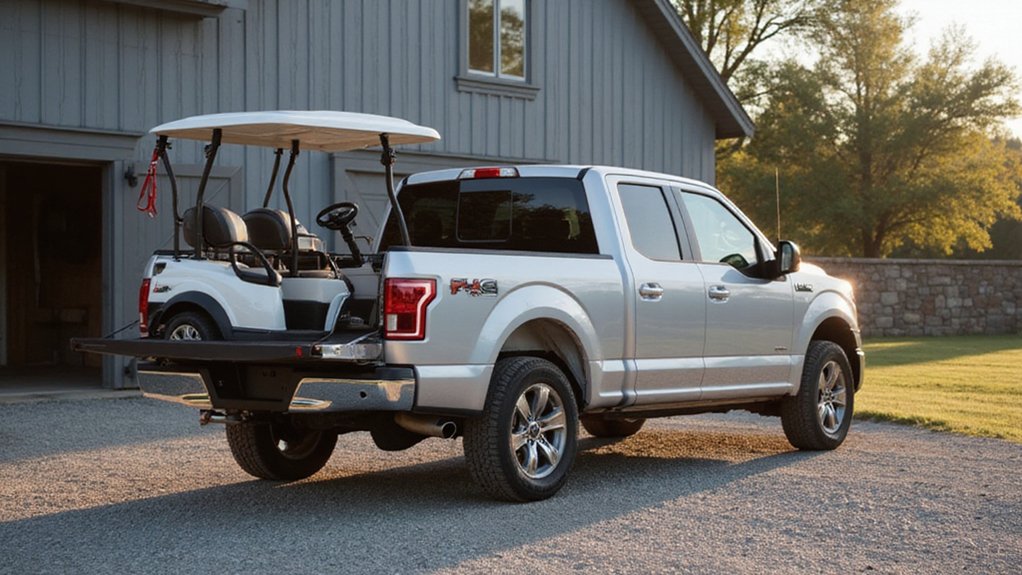
Wondering if your golf cart will fit in your truck bed? The answer depends on your truck’s dimensions and the size of your cart.
Most full-size trucks have a bed width of about 48 to 52 inches. This is close to the standard golf cart width of 48 inches.
By understanding how measurements work, you can figure out if your cart will fit and how to haul it safely. Keep reading to find out everything you need to know.
How to Measure Your Truck Bed for a Golf Cart
Measure the width at the narrowest point between the wheel wells, which is typically around 48 to 50 inches. This measurement is crucial for determining if your golf cart will fit inside the truck bed. Keep in mind that outer bed rails can be misleading because they often appear wider than the usable space. Your golf cart’s width includes tires and any accessories like lifts or custom parts, so compare this widest point to the space between the wheel wells to ensure a proper fit. For example, adding a rear seat grab bar with cup holders can significantly increase the overall width of your cart, requiring careful measurement against the wheel well clearance. For proper functionality, also verify the solenoid specifications on your golf cart, as a high-quality solenoid ensures reliable power delivery during loading and hauling. To keep your battery in top condition during transport, consider using a 48V smart charger that prevents overcharging and extends battery life.
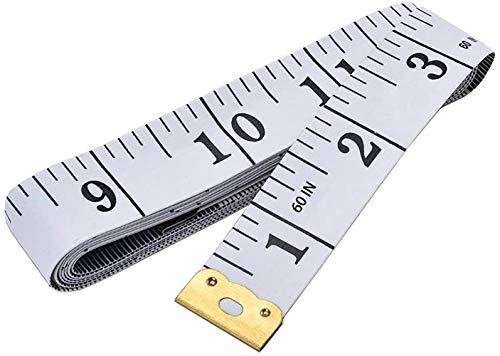
Measuring range: 0 to 60 inches and 0 to 150 centimeters. There is a centimeter scale on the back, which is accurately printed in inches and centimeters. Both sides can be measured according to your requirements. You can put one in your pocket or backpack without taking up too much space
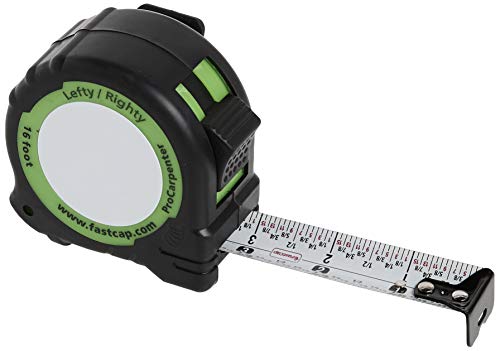
Dual Reading Capability: The Standard/Standard Reverse features standard measurements that are readable when the tape is extended from either the right or left hand

Versatile Convenience: The Peel & Stick tape measure provides a handy tape rule right where you need it. No more fumbling around for a tape measure when you're in the middle of a project
Will a Standard 2-Seater Golf Cart Fit With the Tailgate Up?
A standard 2-seater golf cart, measuring approximately 92 to 96 inches in length, will often not fit in a truck bed with the tailgate up. While the width of most carts, around 48 inches, usually fits comfortably, the length is the main challenge. The overall length includes the front bumper and rear platform overhang, which add to the body measurements. Even though the battery sits low within the chassis, the cart’s wheelbase remains relatively unchanged when loaded, so compression during loading won’t significantly reduce its length. However, if you upgrade to a custom body kit, the cart’s overall length may increase, further complicating a fit with the tailgate up. To maintain peak performance during transport, consider that the cart relies on deep-cycle batteries for its power supply. Additionally, if you have installed a lift kit, the increased height will not affect truck bed length but may make the cart too tall to clear a tonneau cover when loaded. If your truck bed is on the shorter side, a cart near 92 inches might just fit with the tailgate up, but anything exceeding 96 inches will likely require lowering the tailgate for clearance. To ensure a proper fit, measure your truck bed’s usable length and compare it to your cart’s full length. Keep in mind that plenty of longer beds can accommodate most standard carts with the tailgate up, but shorter beds may necessitate dropping the tailgate for transport.

[Applicability] Golf cart trailer hitch is suitable for most golf cart rear seats of Club car, EZGO and Yamaha. Mounts under the rear foot platform. Some simple modifications can be made if you have a longer foot platform.

10L0L Golf Cart Trailer Hitch Fits the Following Cart(s): Fits for Most of Club Car, EZGO, Yamaha, Compatible with most rear seat steps or otherwise made of steel for easy welding.

[Enhanced Golf Cart Versatility] The Golf Cart Trailer Hitch with 2" Receiver is designed to fit the back seat of most golf carts on the market. Compatible with popular brands like Club Car, EZGO, and Yamaha, this trailer hitch allows you to expand the functionality of your golf cart. The 2" receiver hitch accepts tow balls of any size, providing versatility for various towing needs.
Can a Short Bed Still Haul a Golf Cart? Yes: With the Tailgate Down
A short bed can still haul a standard two-seater golf cart when you drop the tailgate. Lowering it increases the bed length by roughly 18 to 22 inches, helping bridge the gap between your 5.5- or 6-foot bed and the golf cart’s 92 to 96 inches in length. This simple adjustment allows the cart to fit with some overhang. However, because the cart extends past the tailgate, you’ll need to secure it firmly to prevent shifting during transit. Investing in a custom cover protects the cart from road debris and weather while hauling. Installing custom bed liners protects your truck bed from scratches and damage, while adding tie-down anchors and a ramp system helps keep the golf cart stable and easier to load. Always back the cart into your truck bed to minimize tailgate stress, and load on flat ground for safety. For those seeking top performance, top lithium golf carts offer superior quality and value. A polycarbonate windshield provides excellent durability against impacts during transport, keeping the cart’s front end protected. Though it’s not a perfect fit, with proper securing and careful handling, a short bed can effectively transport a golf cart.
Check Wheel-Well Width Before Loading Your Golf Cart
Check the width of your wheel wells before loading your golf cart. Measure the narrowest spot between the inside edges of the wells, not the outer bed walls. Full-size trucks typically offer between 48 and 52 inches, while mid-size trucks often range from 41 to 45 inches. Since a standard golf cart usually measures around 48 inches wide, there is little margin for error. If the cart cannot sit flat between the wells, it won’t sit level, which is unsafe. An improper fit can also damage your bed liner from repeated scraping or gouging. Additionally, an uneven load can cause the tailgate to not seal properly, reducing weather protection. Always measure carefully first—width is the main pass-fail criterion for loading your golf cart.
Will a 4- or 6-Passenger Golf Cart Fit in a Pickup Bed?
A 4-passenger golf cart generally fits in a pickup bed, but size and bed length are key factors. Most 4-passenger carts measure between 105 and 128 inches, which can exceed a standard 6.5-foot bed that’s typically around 78 inches long. Even an 8-foot bed, at 96 inches, often struggles to fully contain a lifted 4-passenger cart. The width, usually between 48 and 52 inches, usually clears wheel wells, but overall length is the main limitation. Height can also be a concern; at 70 to 76 inches, taller carts might require a lifted tailgate or open bed. To be sure, measure your cart’s exact length and compare it to your truck’s bed dimensions.

PRECISION FIT: This golf cart drivable rain enclosure Fits Club Car Tempo & Onward 4-Passenger 88 Inch Extended Roof Only. (Note: Does not fit 2-seat or short-roof 4-seat carts. Please check your cart before ordering)

PERFECT FIT: Our golf cart trailer hitch is designed to fit most rear seats on Club Car, EZGO and Yamaha golf carts. It mounts easily under the rear footrest and can accommodate longer footrests with a simple modification. With a 2" receiver hitch to accept any size trailer ball, it provides versatility for a variety of towing needs.
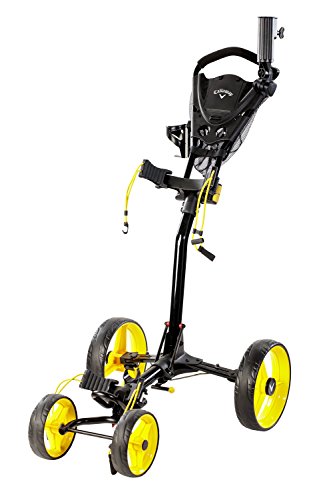
Push Golf Cart: The Trek features a 4-wheel base for added stability on the course - prevents the cart from easily tipping over on uneven terrain, the perfect golf caddy cart!
Do You Need Loading Ramps for a Golf Cart?
Loading ramps are essential for safely getting a golf cart into a truck bed. Choose ramps rated for at least 1,500 pounds per set because your cart’s loaded weight, not just its base weight, determines the requirement. Align the ramps with the wheel tracks on level ground and drive up slowly at walking speed to prevent uncontrolled movement or undercarriage scraping. For additional safety during transit, consider installing top rear view mirrors to improve visibility of your surroundings. Look for ramps with side walls or kick stops to help keep the tires centered, and safety straps to prevent slippage during loading. Before starting, check your battery maintenance—heavy, shifting loads can stress electrical connections. Also, verify tire pressure because underinflated tires flex more, making the climb unstable or harder. A high-quality Bluetooth speaker can also enhance the hauling experience by providing clear music or instructions as you work. When the angle becomes steep, use a spotter to assist and monitor your progress. Avoid flimsy ramps; opt for solid, arched designs that reduce bottoming out and provide more stability. Properly chosen ramps make loading safer and easier, preventing accidents and damage. If you plan to upgrade your cart’s audio for entertainment during hauling trips, check out the best radios for ezgo to find a weather-resistant option.

1800 LBS Load Capacity: This car ramp supports up to 1800 pounds and is made from high-quality aluminum, making it lightweight and durable. It features a double-thickness design of bearing center area and 23 crossbars for enhanced support and stability. Full welding ensures secure connections, and a wider main beam increases load capacity. The design also includes no sharp edges for user safety.

SHED RAMPS - The set of 2 ATV ramps are the perfect solution for getting your ATV, motorcycle, or mower safely into a trailer or shed. Each trailer ramp can be bolted together (bolts not included) for 17-inches across of angled track.

2 Ramps for ATVs & UTVs — Designed for dual-track loading into pickup trucks and trailers. Position the two ramps to match the equipment’s wheel spacing for ATVs, UTVs, four-wheelers, riding mowers, garden tractors, and similar wheeled equipment.
How to Properly Secure a Golf Cart in a Pickup Bed
To properly secure a golf cart in a pickup bed, you should use four heavy-duty ratchet straps—two at the front and two at the rear. Attach them to the cart’s structural frame or axle, avoiding body panels to prevent damage. Run the straps in a crisscross pattern to minimize movement during transit. Gradually tighten each strap, ensuring even tension across all points. After securing, recheck the tension after the first few miles, as straps tend to settle. Before strapping, put the golf cart in park, set the parking brake, and turn the cart off to ensure battery safety and prevent electrical issues. Choosing a lithium battery can reduce weight and improve hauling efficiency compared to lead-acid options. Center the cart in the bed and verify it sits level to distribute weight evenly. Always inspect your straps for fraying or damage before use. Check local road regulations to see if additional visibility markers, such as flags, are required. In Texas, you must also ensure your cart meets street legal requirements if you plan to drive it on public roads rather than just hauling it. Upgrading the cart’s controller can improve its drive control and overall hauling safety. Proper tension and securement are essential for preventing shifting during braking, keeping both you and others safe while on the road.

AMERICAN OWNED, FAMILY OPERATED - Join the Rhino USA Family and Support a Father/Son Business With USA-Based Live Phone Support.

Dimensions and Packages:Tie Down Straps are 1"(wide)x 15'(long) size.Package include: 4x Durable metal ratchet buckles with 8 heavy-duty Coated S Hooks,4x extra soft loops

AMERICAN OWNED, FAMILY OPERATED - Join the Rhino USA Family and Support a Father/Son Business With the Best USA-Based Customer Support.
Short Bed? Use a Trailer for Your Golf Cart Instead
If your pickup bed is shorter than 7 feet, fitting a standard golf cart directly inside becomes problematic. The main issue is length mismatch, which can lead to dangerous tailgate overhang and unstable loading. To avoid these problems, using a trailer is the better choice. A 5×10 flatbed trailer provides enough space for the cart and includes tie-down areas, reducing overhang risks and offering increased stability. Make sure your trailer’s load capacity can handle the golf cart’s weight, which ranges from 800 to 1,100 pounds, plus ramps and straps—always verify the trailer’s payload rating before hauling. Understanding the real price ranges of different golf cart models can help you select a trailer with the right capacity and quality for your specific cart. For four-passenger carts, consider a 6×12 trailer, while six-passenger models typically require a 6×14 or 7×14 size. It’s advisable to select a trailer that exceeds your cart’s length by about 2 feet for proper placement and secure loading. Using a trailer designed for golf carts ensures safer, more stable transport with proper geometry and tie-down points at all four corners, making it a smarter choice than forcing a cramped short bed. For the best experience, look for a trailer that matches the quality and performance of your top golf cart picks. Additionally, protecting your cart during transport or storage can be enhanced by choosing a cover with doors that provides easy access while shielding against weather and road debris.
3 Common Mistakes That Damage Golf Carts During Transport
Even when your golf cart fits the trailer perfectly, common transport mistakes can still cause significant damage. First, avoid relying on just two straps or weak tie-down points. Use at least four straps secured firmly to the frame or axles, avoiding plastic panels. Uneven tension or worn straps can allow the cart to shift during braking or turns, risking trailer compatibility and damaging the cart’s alignment. Choosing a proper hinge option for your windshield also reduces stress during transport by allowing the glass to flex without cracking.
Second, never let straps contact painted bodywork without padding. Abrasion can scratch or pressure damage the paint, and over-tightening can compress the suspension. Always add protective padding around contact points to prevent scuffs and dents.
Third, preventing movement is crucial. Relying solely on the parking brake isn’t enough. Use wheel chocks on both sides of the tires and center the cart for balanced weight distribution. Also, secure the battery by disconnecting its terminals and ensuring the power is off, which reduces the risk of electrical shorts caused by vibrations. Choosing lithium-ion options can help avoid damage during transport, as these batteries are lighter and more vibration-resistant than traditional lead-acid types. Before hitting the road, double-check all straps and tension to keep your cart secure and protected during transport.