Upgrading your Yamaha’s controller is the single biggest performance leap you can make, instantly sharpening throttle response and climbing power. But with amperage ratings from 300A to 500A and options like Bluetooth tuning, choosing wrong means wasted cash or a sluggish cart. Let’s break down the top 10 picks so you match the right brain to your cart’s soul.
Navitas Controller Kit for Yamaha G29
https://m.media-amazon.com/images/I/71bIHd87DUL._AC_SX679_.jpg
The Navitas 440-Amp Controller Kit is the complete package for Yamaha G29 owners (2007-2020) who want a straightforward power boost without replacing their motor. It integrates your existing motor, solenoid, and wiring, simplifying the whole ordeal. Expect speed gains of 1-3 mph and better efficiency at lower speeds, which directly translates to increased range.
Here’s what you get:
- Navitas 440-Amp Controller with a plug-and-play 16-pin harness.
- MODZ Heavy Duty Solenoid to handle high amperage loads safely.
Plus, the Bluetooth app gives you live battery voltage tracking, a built-in speedometer, gear indicator, and one-click car lockout. Motor over-speed protection keeps things safe, and the compact design makes installation a breeze. Customer feedback is flawless, and at about 6.5 pounds, this kit delivers without the bulk.
Factors to Consider When Choosing a Controller for Yamaha Golf Cart
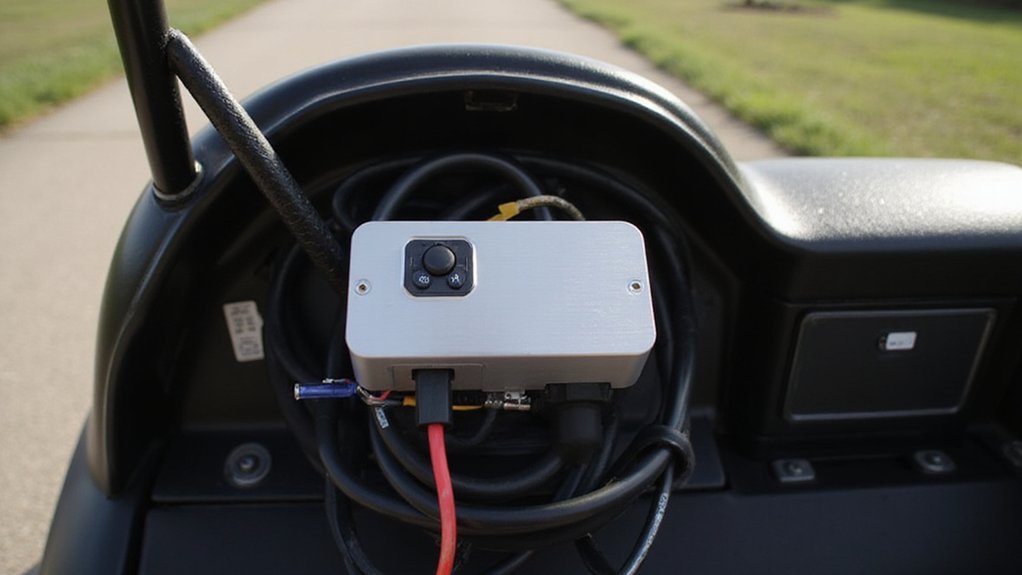
When you’re picking a controller for your Yamaha golf cart, you’ll first need to match the voltage and amp ratings to your battery system and motor’s demands. You should also look for a plug-and-play fit to avoid rewiring headaches, and make certain the controller is compatible with your motor type, whether it’s a stock or high-torque unit. Finally, think about the performance gains you need, and don’t overlook handy app and Bluetooth features for on-the-fly tuning and diagnostics.
Voltage and Amp Ratings
Why do voltage and amp ratings matter so much when you’re picking a controller for your Yamaha golf cart? They’re the backbone of your upgrade, perfectly linking power and safety. Your cart likely runs on a 36V or 48V system. Stick with that voltage unless you’re ready to upgrade your battery and wiring too, because a higher voltage controller means more speed and torque, but it demands compatible hardware.
Amp ratings tell you the current your controller can handle. Common options are 300A, 325A, or 500A. You need one that meets or exceeds your motor’s requirements. Undersize it, and you risk overloading and failure. Oversize it a bit, and you get headroom for reliable performance.
Plug-and-Play Fit
If you want the easiest possible upgrade, a plug-and-play controller is the way to go. It connects directly to your existing wiring without cutting or splicing anything. That means you avoid complex modifications, saving you time and eliminating common errors.
These controllers come with matching harnesses and connectors, ensuring a secure, reliable fit. Compatibility with factory connectors is key, so check your Yamaha’s specific model year. A plug-and-play system preserves your original setup, keeping safety features and electrical layouts intact.
What you get is a straightforward swap. No guessing, no messing with wires. Just match the connectors, bolt it in, and you’re ready to roll. It’s that simple.
Motor Compatibility
After that straightforward swap, you’ve got to make sure the controller actually works with your motor. First, it must match your specific Yamaha model and year. Check the voltage too: 36V or 48V? Match it to your cart’s electrical system or you’ll get nada. And don’t forget the motor type. Does your Yamaha use a regen or series wound motor? Your controller must support that specific type.
Next, get the amperage right. Pair your controller’s rating with your motor’s power needs. Too low, and you’ll starve it. Too high, and you risk damage. Finally, check wiring and connectors. A plug-and-play setup saves you headaches, so look for existing compatibility. Get these four points right, and you’re golden!
Performance Gains Needed
Now let’s talk performance gains. You’re probably after more speed, better torque, or both. Higher performance controllers can boost your Yamaha’s top speed by up to 23 mph, turning your cruise into a brisk ride. Upgrading to a controller with higher amperage capacity enhances torque and acceleration, so you’ll feel that punch when you step on the pedal.
- Hill climbing: you’ll conquer steep inclines with ease, thanks to improved power delivery.
- Handling: rugged terrain becomes more manageable, smoothing out bumpy paths.
- Regenerative braking: this feature recaptures energy, boosting efficiency and giving you a smoother stop.
Just match the controller to your cart’s voltage system, whether 36V or 48V, for superior power. You’ll notice the difference immediately.
App and Bluetooth Features
Performance upgrades don’t stop at raw power. You also need a brain for your cart, and Bluetooth–enabled controllers give you that. Connect your smartphone via the app and you’ll monitor real time battery voltage, speed, and get diagnostic alerts without leaving the driver’s seat.
Want to adjust top speed, braking, or acceleration? Do it on the fly through the app. No need to even pop the controller cover.
Bluetooth also adds serious security. You can remotely lockout your cart or enable performance locking, so unwanted joyriders stay put. And firmware updates? They’re just a tap away, keeping your controller optimized for your course.
In short, a Bluetooth controller transforms your Yamaha into a customizable, connected ride. It’s smart, it’s simple, and it puts total control in your pocket.
Warranty and Support Options
What’s a powerhouse controller worth if you can’t get help when it acts up? That’s why you need a rock-solid warranty and responsive support. Look for a all-encompassing warranty that covers both parts and labor for at least one year. That way, you won’t get stuck with costly repairs. Check the manufacturer’s reputation for fast, helpful customer service and easy access to detailed manuals or troubleshooting guides. And for extra peace of mind, choose a controller with Bluetooth or app‑enabled support. These features let you run remote diagnostics, monitor performance, and get quick updates. That cuts downtime and saves you money on support calls. So, before you buy, confirm you’re covered, and you’ll ride with confidence.