Are you wondering which golf carts are made entirely in the United States? If so, you’ll find that only a few brands build their carts completely domestically, primarily in Georgia.
Others assemble carts here but use imported parts, so verifying manufacturing details is key.
Stay tuned to learn exactly how each brand measures up and which ones are truly American-made.
What “Made in the USA” Means for Golf Cart Buyers
Seeing “Made in the USA” on a golf cart doesn’t guarantee every component is domestic. The Federal Trade Commission requires products to be “all or virtually all” made here, meaning the final assembly and all significant processing must take place within the United States. However, a cart can be assembled domestically but still contain imported batteries, motors, or frames. It’s essential to understand that the label alone doesn’t verify supply chain integrity. Manufacturers must have a reasonable basis for their claims at the time of making them, but supply chain transparency isn’t always clear. To ensure you’re getting a genuinely domestic product, ask questions about where major components come from. For example, evaluating tube reviews can help confirm the quality of imported parts. Labels like “Assembled in USA” are weaker and more vague, so verify the origin details rather than assuming they meet the same standards. A higher price tag doesn’t automatically mean the cart complies with these domestic manufacturing claims. In comparison, selecting a light bar for your golf cart involves similar scrutiny of component sourcing and assembly claims. When evaluating a cart’s overall build, you should also compare it against top-rated reviews to confirm its quality and performance match your needs.
Georgia: The Heart of U.S. Golf Cart Manufacturing
Georgia’s golf cart industry is a powerhouse. It directly contributes around $679 million to the economy and nearly $1.1 billion when including all associated impacts. This concentration of brands, skilled labor, and distribution hubs in areas like Brunswick and Jasper provides a manufacturing advantage that’s hard to match elsewhere. It means faster turnaround times, better supply chain coordination, and easier access to a trained workforce. If you’re sourcing or manufacturing in this region, you’re tapping into a well-established ecosystem that supports efficient, high-quality production. For buyers upgrading their carts, selecting the right 6 volt lithium battery can further improve performance and longevity. To protect your investment, pairing your cart with a top windshield ensures clear visibility and durability on the course. Mastering safe golf cart driving is essential for both course and street etiquette.
The Big Three: Club Car, E-Z-GO, and Yamaha
Yamaha entered U.S. production in 1988 at its Newnan, Georgia plant. Although Yamaha is a Japanese parent company, the North American models rely on American assembly, ensuring they meet high manufacturing standards. To keep these carts running reliably, owners should know how to test the charger safely using a multimeter and proper procedures. All three brands—Club Car, E-Z-GO, and Yamaha—offer reliable, U.S.-built options. Club Car and E-Z-GO are the most purely American, with manufacturing rooted entirely in the United States, whereas Yamaha combines global engineering expertise with local production. This blend allows Yamaha to deliver models that meet American quality standards while benefiting from international design and development. For optimal performance, many owners pair these U.S.-built carts with a 48 volt lithium battery to extend range and reduce weight. When comparing these brands, buyers often evaluate performance and value across the top models to ensure they select a cart that fits their specific needs.

【ULTRA HIGH PERFORMANCE - CLASS A BATTERY】: LOSSIGY 48V100AH lithium iron phosphate battery for golf carts is made with class A chip, equipped with 58.4V18A smart charger, 9 in1 battery monitor, built-in 200A BMS, 5120W Powerful, 1000A peak current. IP65 waterproof. Perferred item for golf cars, trolling motors.

[10 Years Lifetime and 5000+ Deep Cycles] OGRPHY 48 volt lithium battery is made of new grade A cells with UL certification. 10 years lifetime and 5000+ deep cycles is not just a slogan under instructions on the product manual.

Born for 48V Golf Cart: Special designed for 48v golf cart industry, OGRPHY 48v lithium golf cart battery is compatible with golf cart controllers of all major brands on the market. Built in premium grade A prismatic LiFePO4 cells(UL certified), this 48v battery has better durability & safety. Over 5kWh capacity equals 8pcs 12V 100AH lead acid batteries. Max 10.24kW continuous power & peak 51.2kW power (50% more powerful than standard lithium batteries) to conquer hills/rough terrain effortlessly.
Other Fully U.S.-Made Brands: Cushman, GEM, and Tomberlin
Cushman, GEM, and Tomberlin are all fully U.S.-made brands that assemble their vehicles domestically. Cushman vehicles are built in Augusta, Georgia, and are known for rugged utility models suited for commercial turf and industrial applications. Their local manufacturing helps reduce environmental impact by limiting shipping emissions and supporting American jobs. To protect these vehicles from the elements, owners may consider top golf cart covers similar to options reviewed for Club Car models. For instance, the reviews on Finding the Perfect Ezgo Golf Cart Cover can guide buyers in selecting a durable cover that fits these domestically built models.
GEM, under Polaris, produces low-speed electric vehicles in Anaheim, California. These vehicles are ideal for neighborhood transport and emphasize innovative design for urban mobility needs. As they are assembled in the U.S., you benefit from a smaller carbon footprint compared to imported models.
Tomberlin manufactures street-legal golf carts in Leesburg, Florida. Their focus is on American-built quality for street use and neighborhood navigation. Choosing Tomberlin means opting for vehicles that are designed, assembled, and tested within the United States, reinforcing domestic manufacturing’s advantages. Unlike these domestic brands, Denago carts are imported and may not offer the same American-built quality as U.S.-assembled models.

Fits most Yamaha, Club Car, E-Z-Go two-person golf carts, roof measuring 68"L

[Perfect Fit for 2+2/4 Passenger Golf Carts] : The golf cart cover is custom-designed to fit most 4 seater golf carts, compatible with Yamaha, Club Car, EZGO golf carts etc. Measures 112"L x 54"W x 66"H, with elastic hem and adjustable strap clips to keep it secure even in strong winds. Say goodbye to flapping covers on windy days

PREMIUM ALUMINUM LICENSE PLATE: UV-resistant ink, waterproof, rustproof, and lightweight for lasting quality.
U.S.-Assembled Brands: Advanced EV, American Landmaster, and American Pride
All three brands—Advanced EV, American Landmaster, and American Pride—offer U.S. assembly, but they each emphasize different aspects of domestic manufacturing and customization. Advanced EV assembles street-legal carts in Texas using imported components, providing modern design and a reliable warranty. American Landmaster builds rugged utility vehicles in Indiana, starting with raw steel tubing frames and performing a 112-point inspection to ensure quality, with over 70 percent of parts sourced domestically. These vehicles often perform best when paired with durable turf tires to maximize traction on varied terrain. American Pride hand-builds custom carts in Florida, disassembling and reassembling each vehicle with new OEM parts. Their in-house facilities handle fabrication, painting, and upholstery, allowing for extensive luxury customization options. Each brand’s approach balances U.S. assembly with varying degrees of local content and personalization, all backed by their respective warranty coverage. For buyers focused on performance and value, a detailed review of top lithium golf carts can provide additional guidance on battery-powered alternatives. For those interested in alternative options, a buyer’s guide to remote control golf carts highlights quality and performance comparisons.

Remote Control Electric Golf Cart (All Terrain) – Electric assist walking where the cart does the work so you can enjoy the walk, moving with you using adjustable speed control (1–20). Control it hands-free with the remote, or switch to the handle for added precision in tighter areas. Features dual oversized all-terrain swiveling front wheels, all-terrain tread rear wheels, and a rear stabilizer (5th wheel) for maximum stability.

Non-Remote Control Electric – Enjoy the walk without carrying, pushing, or riding. Steer and control hands-on with adjustable speed 1–20. Swiveling front wheels, all-terrain rear wheels, and 5th wheel stabilizer.

Zip Fold Technology-Innovative & compact one piece frame engineered zip fold system will make setup easy and quick to and from the course. Newly Engineered Zip Fold System is 12% lighter and 25% smaller for easy transport and space savings to and from the course. The rear wheels can be inverted on the axle to reduce the size of the footprint when not in use. Folded Dimensions (Inverted Rear Wheels); 27.55 X 18.5 x 16.5 Inches. Weight (No Battery) 30.91 LBS (With Battery: 37.31 LBS)
Mixed-Sourcing Brands: Evolution, Denago, and Others
Many brands that assemble their golf carts in the U.S. still rely on imported components, making their supply chains mixed. For example, Evolution, with assembly plants in California, Florida, and Texas, explicitly confirms its parts originate from China. This means its models are assembled domestically but incorporate foreign-made components. When comparing these models, electric models from Evolution can be contrasted with gas-powered alternatives found in domestic or foreign brands. Similarly, Denago’s Texas-based factory focuses on assembling first-generation carts, but does not fully source all parts domestically. For those seeking simpler transportation, the Best Small Electric Golf Carts for adults often prioritize compact size over domestic assembly.
Evaluating supply chain transparency becomes crucial in these cases. If you cannot verify where components come from, you risk compromising quality control beyond the final assembly. The phrase “assembled in the USA” often indicates a mixed-sourcing approach, where foreign subassemblies are incorporated into products. This distinction affects your understanding of manufacturing standards, as complete domestic sourcing involves controlling the supply chain from raw materials to finished product.
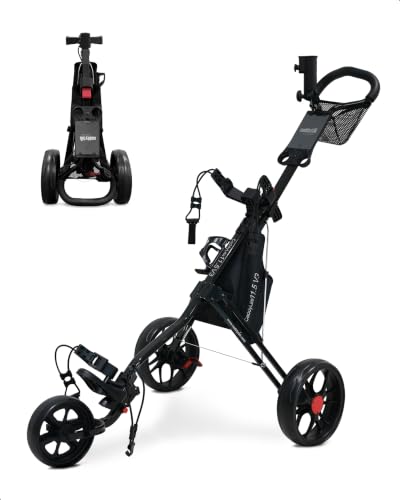
EASY FOLDING & PORTABILITY: This golf push cart features a 3-step quad-fold system that folds in seconds for compact storage. At just 13.75 lbs, this lightweight golf push cart is portable, trunk friendly, and perfect for travel and easy storage.

Lightweight and sturdy, steel Deluxe Golf Cart offers easy mobility on the course

【 Accurate Battery Level Monitoring】 This professional battery indicator accurately detects and displays remaining power for all kinds of battery-powered equipment and electric vehicles. It delivers stable and real-time battery data, allowing you to grasp battery usage status at any time and avoid sudden power loss during use.
How to Verify an American-Made Golf Cart Claim
To verify that a golf cart is genuinely American-made, start by examining the VIN. A legitimate street-legal cart should have a 17-character VIN, not a short serial number. Use a federal VIN decoder to analyze it; this will reveal the build plant and country of manufacture. If the VIN decodes correctly, you have stronger evidence than just a seller’s claim. Next, check for a DOT compliance label, which should include the VIN and certify that the vehicle meets FMVSS 500 standards. Match that VIN with your title or manufacturer’s certificate of origin. Any discrepancies between these documents are red flags indicating the cart may not be truly American-made. Lastly, contact the manufacturer directly to confirm final assembly location. They should provide records showing the cart was assembled in the U.S., not just manufactured elsewhere and simply imported or assembled domestically. Documentation aligned with import/export regulations offers the best proof of American production.