You’re cruising the fairway when your cart suddenly dies, and the culprit is often a tiny solenoid. Keeping ten reliable spares handy turns a frustrating afternoon into a five-minute fix. From 36V universal fitments to heavy-duty 48V contactors, you’ll need options that match your EZGO, Club Car, or Yamaha perfectly. But choosing wisely matters, since voltage ratings and continuous duty specs make all the difference.
| MaySpare 36V Golf Cart Solenoid |  | Best for Club Cars | Voltage: 36V | Terminal Count: 4 terminals | Current Rating: Not specified | VIEW LATEST PRICE | Read Our Analysis |
| 10L0L #70 Series Solenoid Relay for EZGO Golf Cart |  | Most Compatible | Voltage: 36V | Terminal Count: 4 terminals | Current Rating: Not specified | VIEW LATEST PRICE | Read Our Analysis |
| ApplianPar 48V 400A Main Contactor Solenoid for Heavy Duty Golf Cart Car |  | Heavy-Duty Power | Voltage: 48V | Terminal Count: Not specified | Current Rating: 400A | VIEW LATEST PRICE | Read Our Analysis |
| 10L0L 48V Golf Cart Solenoid for EZGO |  | Best for Modern EZGO | Voltage: 48V | Terminal Count: Not specified | Current Rating: Not specified | VIEW LATEST PRICE | Read Our Analysis |
| 14V Golf Cart Solenoid | Best for Gas Models | Voltage: 14V | Terminal Count: 4 terminals | Current Rating: 200A | VIEW LATEST PRICE | Read Our Analysis | |
| MODZ Golf Cart Universal (400 Amp) 48 Volt Heavy Duty Solenoid | 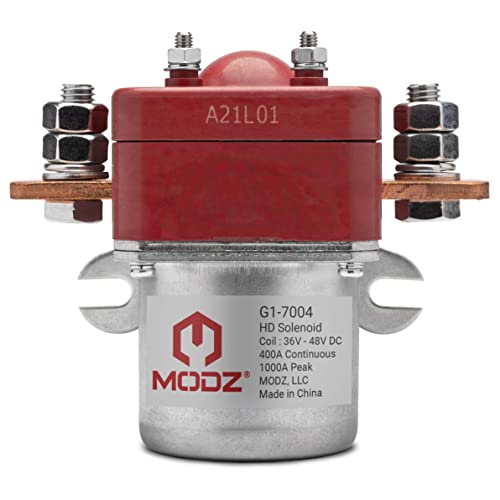 | High-Performance Pick | Voltage: 48V | Terminal Count: 2 high amperage, 2 activation (4 total) | Current Rating: 400A continuous, 1000A peak | VIEW LATEST PRICE | Read Our Analysis |
| 14V Golf Cart Solenoid for EZGO TXT Gas Golf Cart 1994-Up |  | Reliable Replacement | Voltage: 14V | Terminal Count: 4 terminals | Current Rating: Not specified | VIEW LATEST PRICE | Read Our Analysis |
| 10L0L Golf Cart Solenoid 12V Club Car DS |  | Best for Gas Club Cars | Voltage: 12V | Terminal Count: 4 terminals | Current Rating: Under 200A working, 80A recommended | VIEW LATEST PRICE | Read Our Analysis |
| Heavy Duty 48V Golf Cart Solenoid for Yamaha G22/G29 |  | Best for Yamaha | Voltage: 48V | Terminal Count: 4 terminals | Current Rating: Not specified | VIEW LATEST PRICE | Read Our Analysis |
| 10L0L Continuous Duty Solenoid for EZGO Golf Cart | 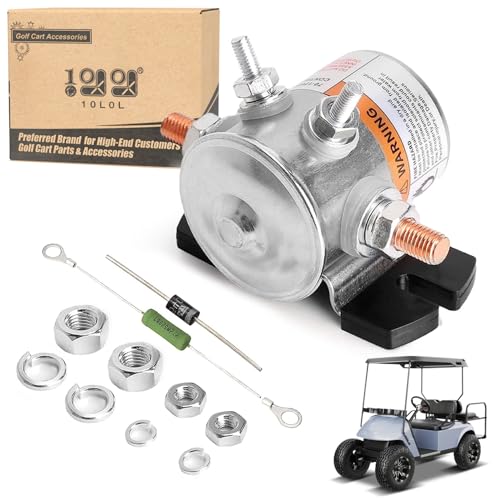 | Continuous Duty | Voltage: 36V | Terminal Count: 4 terminals | Current Rating: Not specified | VIEW LATEST PRICE | Read Our Analysis |
More Details on Our Top Picks
MaySpare 36V Golf Cart Solenoid
If you’re driving a Club Car DS from 1976 to 1998, this MaySpare 36V solenoid aligns perfectly with your cart. It’s a non-OEM part, matching #8016, with four terminals for solid connections. Just don’t overtighten those nuts; you’ll crack the posts. Customers love it, giving it 4.5 stars out of five across 515 reviews. That’s a strong signal. And if you spot a lower price elsewhere, report it with the store details and shipping costs. MaySpare keeps prices competitive that way. Check the UPC: 727196532305. Brand reliability, right there.
- Voltage:36V
- Terminal Count:4 terminals
- Current Rating:Not specified
- Compatible Brands:Club Car
- Contact Material:Not specified
- Weight:Not specified
- Additional Feature:Avoid overtightening terminal nuts
- Additional Feature:1976-1998 Club Car DS compatible
- Additional Feature:4-terminal design
10L0L #70 Series Solenoid Relay for EZGO Golf Cart
You’re working on an older EZGO golf cart, and the 10L0L #70 Series Solenoid Relay is your most compatible fix for the 36-volt models. It fits TXT, Medalist, and Marathon carts from 1971 to 2010, plus Columbia and Melex models. This SPNO relay uses screw-type connections for a secure install. Its copper contacts handle continuous duty reliably, and you’ll get 786 reviews backing its 4.5-star rating. Replace OEM parts like 70-120224 or 27855-G01. Just note the 50°C upper temperature rating, so keep it away from extreme heat. It’s a straightforward swap that gets your cart moving again.
- Voltage:36V
- Terminal Count:4 terminals
- Current Rating:Not specified
- Compatible Brands:EZGO, Columbia, Melex, Pargo, others
- Contact Material:Copper
- Weight:Not specified
- Additional Feature:50°C temperature rating
- Additional Feature:5 watts power consumption
- Additional Feature:Screw-type connections
ApplianPar 48V 400A Main Contactor Solenoid for Heavy Duty Golf Cart Car
The ApplianPar 48V 400A main contactor solenoid is the ideal choice for golf cart owners who demand genuine heavy-duty power. It’s rated for high voltage and current, so you get reliable switching without fail. Here’s what you need to know:
- Specs: 48V, 400A, with M10x1.5 threads and a 6mm mounting hole diameter. Weighs just 2.03 pounds.
- Usage: Perfect for your heavy-duty golf cart’s main electrical connection control. You’ll appreciate the robust build.
It arrived on the market July 27, 2023, and boasts a 4.1 star rating from 12 reviews. Plus, you’ve got a 30 day return window. Grab one and upgrade your cart’s power system today!
- Voltage:48V
- Terminal Count:Not specified
- Current Rating:400A
- Compatible Brands:Universal (heavy duty)
- Contact Material:Not specified
- Weight:2.03 pounds
- Additional Feature:6mm mounting hole diameter
- Additional Feature:M10x1.5 thread size
- Additional Feature:2.03 pounds weight
10L0L 48V Golf Cart Solenoid for EZGO
Need a reliable solenoid for modern EZGO models? You’ll want the 10L0L 48V Golf Cart Solenoid, OEM# 612711. It’s built specifically for EZGO TXT models from 2010 onward and all 48V MPT 800/1000 vehicles. But don’t try it on 36V carts or RXV models, it won’t work. With a solid 4.4 out of 5 stars from 149 reviews, other owners trust it. The package includes one solenoid, and Amazon gives you a 30 day return guarantee. Plus, you can report a lower price if you find one, prompting Amazon to check competitiveness. Keep one handy for quick swaps.
- Voltage:48V
- Terminal Count:Not specified
- Current Rating:Not specified
- Compatible Brands:EZGO
- Contact Material:Not specified
- Weight:Not specified
- Additional Feature:2010+ EZGO TXT compatible
- Additional Feature:Not for RXV models
- Additional Feature:Not for 36-volt vehicles
14V Golf Cart Solenoid
If your gas powered EZGO or Cushman is a 1994 to 2008 model, this 14V solenoid is a solid fit. It swaps in for part numbers 27153G01 or 612813, but double check your cart before buying. You won’t want it on an RXV, though.
This 200 amp, 4 terminal unit handles a critical job. It converts electrical energy into mechanical action to fire up your ignition system. When it fails, your cart won’t move.
Installation is straightforward, but always disconnect the power source first. You’ll find durable copper coil contacts and a steel sheet inside a plastic shell. The package includes the solenoid and metal bracket. It weighs just 7 ounces and measures 3.31 x 3.19 x 2.83 inches. Backed by a 30 day return policy.
- Voltage:14V
- Terminal Count:4 terminals
- Current Rating:200A
- Compatible Brands:EZGO, Cushman
- Contact Material:Copper
- Weight:7 ounces
- Additional Feature:For 1994-2008 gas models
- Additional Feature:Not compatible with RXV
- Additional Feature:Metal bracket included
MODZ Golf Cart Universal (400 Amp) 48 Volt Heavy Duty Solenoid
Looking for a heavy duty solenoid that can handle serious amperage without breaking a sweat? The MODZ Golf Cart Universal (400 Amp) 48 Volt Heavy Duty Solenoid is your answer. It packs a 400 Amp continuous and 1,000 Amp peak capacity, perfect for your high-performance ride. You’ll appreciate its compatibility with controllers rated between 500-600 Amps, managing that heavy load between batteries and controller smoothly. The integrated mounting bracket makes installation a breeze, and those high amperage circuit posts with double nuts ensure secure connections. With a 4.3-star rating from 60 reviews and a one-year warranty, you’re getting reliable power without the fuss.
- Voltage:48V
- Terminal Count:2 high amperage, 2 activation (4 total)
- Current Rating:400A continuous, 1000A peak
- Compatible Brands:Universal
- Contact Material:Not specified
- Weight:Not specified
- Additional Feature:1000A peak capacity
- Additional Feature:Integrated mounting bracket
- Additional Feature:500-600A controller compatible
14V Golf Cart Solenoid for EZGO TXT Gas Golf Cart 1994-Up
You’re dealing with a finicky starter on your 1994-up EZGO TXT gas cart, and the 14V solenoid from HNeekyr is your reliable replacement. This little copper coil contact, wrapped in steel and plastic, shrugs off rust and keeps cranking year after year. It’s a direct swap for part numbers 27153G01 and 612813, so no fussing with adapters. Here’s what fits:
- EZGO TXT, Medalist, 875, and 1994-up Shuttle models
- Also works on ST Express, ST Shuttle, ST Sport, ST 350, and Cushman 2200
- Not for RXV models, so double-check yours
It comes with a 30-day return policy and a solid 4.3-star rating. Keep it handy for quick starter fixes!
- Voltage:14V
- Terminal Count:4 terminals
- Current Rating:Not specified
- Compatible Brands:EZGO, Cushman
- Contact Material:Copper
- Weight:8.8 ounces
- Additional Feature:Copper coil contacts
- Additional Feature:Steel sheet construction
- Additional Feature:Rust-resistant housing
10L0L Golf Cart Solenoid 12V Club Car DS
This solenoid is built for gas powered Club Cars. It’s a 12V workhorse for your 1984-up DS or 2004-up Precedent. You’ll get copper contacts for durability. Here’s what you need to know:
- Voltage: 12V, with a working current under 200A.
- Coil Current: 0.65A, motor power limit at 1.2KW.
- Best Practice: Keep your operational current around 80A to extend its life.
It replaces OEM parts like 1013609 or 1012275. And with 4 terminals, installation is straightforward. Rated 4.5 stars from 288 reviews, it’s a solid choice you can rely on. Keep one handy!
- Voltage:12V
- Terminal Count:4 terminals
- Current Rating:Under 200A working, 80A recommended
- Compatible Brands:Club Car
- Contact Material:Copper
- Weight:14.4 ounces
- Additional Feature:1.2KW motor power limit
- Additional Feature:0.65A coil current
- Additional Feature:Recommended 80A operating current
Heavy Duty 48V Golf Cart Solenoid for Yamaha G22/G29
Yamaha G22/G29 owners from 2007 onward, this solenoid is your direct fit. It replaces OEM numbers JU6-H1950-00, JU6-H1950-00-00, and JU6H19500000, so no guesswork. Its four terminals and silver contacts manage your 48V system efficiently, improving energy flow while reducing unnecessary drain. You get a waterproof, dustproof construction that handles heavy use. Installation is straightforward: panel mount it, then let it cool after long runs to prevent burnout. Weight is just 16 ounces. A one-year warranty backs it. Check dimensions before buying, and you are set for reliable starts every time.
- Voltage:48V
- Terminal Count:4 terminals
- Current Rating:Not specified
- Compatible Brands:Yamaha
- Contact Material:Silver
- Weight:16 ounces
- Additional Feature:Silver contacts for conductivity
- Additional Feature:Waterproof and dustproof
- Additional Feature:One-year warranty included
10L0L Continuous Duty Solenoid for EZGO Golf Cart
For EZGO owners running 36V TXT or Marathon carts from 1980 to 2010, this solenoid is the best choice when you need a reliable, continuous duty relay. It replaces OEM parts like 27855G01 and 11761G1, acting as the heavy-duty conduit between your battery and starter motor.
Installation requires care: you must fix the base securely, then clamp wires between inner and outer nuts. Your kit includes a resistor and diode orient the diode’s line toward the positive side. Without correct placement, your ignition won’t activate properly. This copper-contact, normally open solenoid delivers the juice your cart needs, every time!
- Voltage:36V
- Terminal Count:4 terminals
- Current Rating:Not specified
- Compatible Brands:EZGO
- Contact Material:Copper
- Weight:Not specified
- Additional Feature:Kit includes resistor/diode
- Additional Feature:Diode orientation critical
- Additional Feature:Fix base during assembly
Factors to Consider When Choosing a Solenoid for Golf Cart
When you’re picking a solenoid for your golf cart, start with a voltage compatibility check to make sure it matches your battery setup. Then, consider the amperage and duty cycle you need for your motor’s demands, along with the terminal configuration fit and mounting size for a hassle-free install. And don’t forget the OEM replacement number match, as that can save you from a world of headaches down the line!
Voltage Compatibility Check
Why does voltage compatibility matter so much? Simple: your golf cart’s electrical system runs at a specific voltage, typically 36V or 48V. A solenoid’s voltage rating must match that exactly. If you don’t verify this, you risk overheating, component damage, or total failure of your cart’s ignition system. That’s not a cheap fix.
Always confirm the solenoid’s voltage specs against your battery system before you install anything. Look for a clear label on the solenoid itself. Choosing the right rating ensures reliable activation every time you press the pedal. A mismatch? You’ll get sluggish performance or worse, irreversible damage to your wiring or controller. Don’t gamble on this.
Stick with the correct voltage, and your cart will thank you. It’s that straightforward.
Amperage And Duty Cycle
While voltage gets your solenoid in the door, amperage and duty cycle are what keep it from burning out on the job. Amperage is the current your solenoid can handle; pick one with a rating that meets or exceeds your cart’s peak electrical load. Don’t cut it close. Underestimating it invites overheating and premature failure. Duty cycle, meanwhile, dictates how long it can run continuously before needing a break. A higher duty cycle, like 100%, lets you operate in demanding conditions without worry. For heavy-duty use, overestimate both. Here’s what to prioritize:
- Amperage capacity: Match or exceed your cart’s load.
- Duty cycle: Aim higher for extended operation.
Overestimating boosts durability and safety, giving you reliable performance every time you hit the course.
Terminal Configuration Fit
Choosing a solenoid with the right terminal configuration is like making sure a puzzle piece fits before you try to force it in. You’ll want the number of terminals—whether it’s a 4-terminal or 2-terminal setup—to match your cart’s original parts for seamless installation. Check the terminal type too: screw-type or blade connectors? Make sure they’re compatible with your existing wires and connectors for a secure, snug attachment.
You also need to verify that the solenoid’s terminal layout suits your electrical system’s voltage and current requirements. Doing this upfront prevents connection headaches down the line. And here’s the best part: choosing a matching configuration means you won’t need extra adapters or modifications during installation. Keep it simple, and your cart will thank you. Just match the terminals, and you’re golden.
Mounting And Physical Size
Before you fall in love with a solenoid’s electrical specs, measure the darn thing. You can’t force a square peg into a round hole, and your golf cart’s mounting space is unforgiving. Check the bracket holes and overall length, width, and height against your designated spot. A mismatch here means a wasted purchase.
Also, inspect the terminal configuration and spacing. They must line up perfectly with your cart’s wiring harness, or you’ll fight with loose connections. And don’t overlook the mounting method. Whether it’s screw, panel mount, or bracket, it needs to match your cart’s design.
Finally, consider durability. That solenoid will face vibration, moisture, and debris. A robust, well mounted unit handles that abuse. So grab your tape measure and verify those dimensions first. It’s a simple step that saves you a headache later.
OEM Replacement Number Match
Once you’ve confirmed the solenoid fits in your mounting space, the next step is nailing the OEM replacement number. This isn’t just a suggestion; it’s your ticket to a hassle-free swap. Matching that number guarantees the solenoid jives with your cart’s electrical system, slashing the risk of installation errors or operational failures.
You need to verify the number against your vehicle’s make, model, and year. Why? Because OEM numbers are specific, and an incompatible part can cause headaches you don’t want. Cross-referencing assures seamless function with your existing wiring and controls. Plus, you lock in the manufacturer’s durability specs.